One of the things that struck me most when I moved to France in 2012 was just how present churches are in everyday life.
They aren’t tucked away as occasional landmarks or saved for special sightseeing days. They rise over market squares, anchor tiny villages, and appear when you least expect them.
In Paris, I’d be out walking and suddenly find myself in front of Saint-Sulpice or ducking into Saint-Germain-des-Prés, which felt impossibly old compared to almost anything I knew back home.
Then I’d leave the capital to spend a day in Reims, and find myself standing where the kings of France were once crowned.
I eventually started wondering how many churches France has.
And that curiosity is what led to this post.
I’ll share the best answer I can give you, why the number is trickier than it sounds, and what it’s really like to notice churches around every corner.
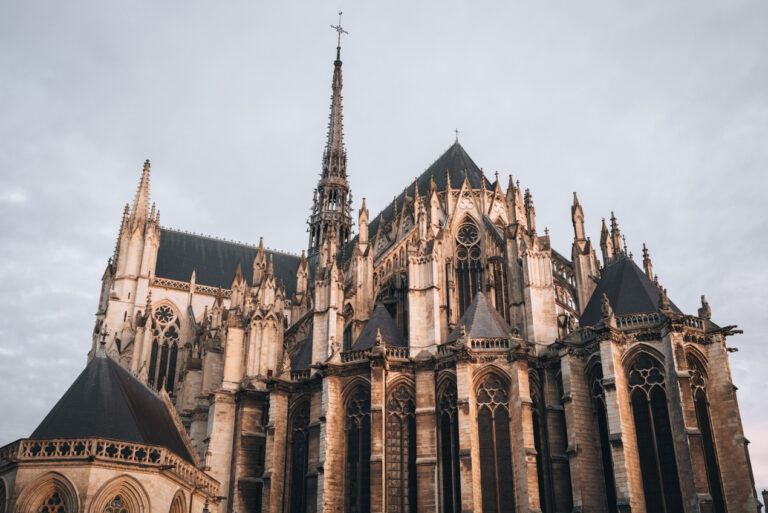
Quick Answer
- Short answer: France has tens of thousands of churches — far more than most travelers expect.
- Commonly cited estimate: roughly 42,000 to 45,000 Catholic churches, depending on the source.
- Why the numbers vary: some counts include only active parish churches, while others fold in chapels, basilicas, abbeys, cathedrals, and historic religious buildings.
- Why France has so many: a long Catholic history, thousands of small communes each built around a church, and a deep link between faith, architecture, and local identity.
How Many Churches Are in France?
If you’re hoping for one exact figure, I have to be honest: it doesn’t really exist. But here’s the closest, most reliable answer.
France has an estimated 42,000 to 45,000 Catholic churches. One report referencing church officials puts the figure at around 42,000 parish churches, while religious heritage reporting cites closer to 45,000 Catholic places of worship.
Broader estimates climb even higher when you add chapels, shrines, and other religious sites.
So why is the number so hard to pin down?
It all comes down to definitions. Some sources count only active parish churches. Others include grand cathedrals in France that draw millions of visitors, the smaller village chapels, historic churches in France that no longer hold regular services, and everything in between.
Change the definition, and you change the total.
What I can tell you from living here is that the sheer volume becomes real the moment you start traveling. French churches aren’t tucked away in a handful of famous cities. They’re woven into nearly every town and village you’ll pass through.
One weekend you might be craning your neck up at a soaring Gothic cathedral, and the next you’ll find a quiet stone chapel in the middle of nowhere that feels just as steeped in history. Whatever the “official” count, France has one of Europe’s richest collections of churches.
Why Are There So Many Churches in France?
There are a few good reasons churches are so common here, and they all tie back to France’s history.
First, there’s the Catholic influence.
Contrary to today, the Catholic Church once sat at the center of French life. Faith wasn’t separate from village life; it was village life. That’s why even the smallest towns still have their own parish church, often the oldest and most striking building around.
Second, there’s the way France is organized.
The country is divided into tens of thousands of communes, and historically, most were built around a central church square. The church was the heart of the community. It was where people gathered, celebrated, and mourned.
And here’s what really stands out to me after living in both a big city and a smaller region.
In Paris, churches sometimes blend into the crowd of monuments and landmarks.
But out in Alsace, where I’ve been based since 2019, the churches are the anchor of each village. They are the first thing you spot as you approach, and often the last thing catching the evening light as you leave.
Seeing both sides of France gave me a real appreciation for how these buildings are stitched into the landscape.
What Counts as a Church in France?
Part of the reason nobody agrees on a number comes down to a simple question: what actually counts as a “church”?
Different sources draw the line in different places. Some keep it strict and only count:
- active parish churches
- Catholic churches still in regular use
- Protestant places of worship
Others take a broader view and also include:
- chapels
- basilicas
- cathedrals
- abbey churches
- pilgrimage sites
- historic religious buildings no longer used for services
You can see how quickly the totals start to shift. A count focused only on working parish churches will land far lower than one that sweeps in every chapel and heritage site across the country.
Honestly, though? As a traveler, you probably won’t be doing that math. What you’ll notice instead is that churches are everywhere; from world-famous landmarks like Notre-Dame de Paris to a modest hillside chapel in the mountains of Alsace that doesn’t even make the guidebooks.
And that, to me, is the real answer to how many churches are in France: more than you can count, and more than you’ll ever expect.
My Top 5 Must-See Churches in France
Narrowing this list down was hard. After more than a decade of living here, I’ve wandered into more French churches than I could ever count.
But if I had to point you toward just five, these are the ones I’d send my own visiting friends to see. Each one stopped me in my tracks for a different reason.
1. Sainte-Chapelle

Tucked away on the Île de la Cité in Paris, Sainte-Chapelle doesn’t look like much from the outside. That’s part of the trick. The first time I visited, I nearly walked past it because it’s surrounded by the old courthouse buildings.
You climb a narrow staircase with no real idea of what’s coming. Then you step into the upper chapel, and honestly? I gasped out loud. So did everyone around me.
The whole room is wrapped in 13th-century stained glass, which is the largest collection of its kind anywhere. Fifteen towering windows tell over a thousand biblical scenes, and on a sunny afternoon the light pours through and scatters color across the stone floor.
I’ve been back several times, and I always tell people the same thing: go on a bright day if you possibly can. The glass needs sunlight to come alive.
One small tip from experience: arrive early or book ahead. The chapel is compact, and it fills up fast with tour groups. On my first visit, I made the rookie mistake of showing up midday in July and spent more time shuffling than gazing. Now I aim for the first slot of the morning, when the light is soft, and the crowds haven’t rolled in yet.
2. Reims Cathedral

Reims Cathedral is one of those historic churches in France that carries the weight of an entire nation’s story. This is where the kings of France were crowned for centuries.
Built between 1211 and 1516, it’s a masterpiece of Gothic architecture, and the façade is absolutely covered in carved figures. There are said to be over 2,000 statues here, including the famous “smiling angel” that has become the symbol of the city.
What always gets me about Reims, though, is how much it has survived. The cathedral was badly damaged during World War I, shelled and burned, and yet here it still stands, painstakingly restored. Standing in front of it, knowing what it’s been through, gives you a very different feeling than admiring a cathedral that’s simply old. This one feels resilient.
I visited on a gray, drizzly afternoon, which I initially grumbled about. But the flat light actually made the stone glow this soft silver-gray, and I ended up lingering far longer than planned.
Pair your visit with a glass of the region’s most famous export; you are in Champagne country, after all, and you’ve got a trip worth planning.
3. Strasbourg Cathedral

I’ll be upfront: this one’s personal. I’ve lived in Strasbourg since 2019, and its Notre Dame Cathedral is my absolute favorite of all the cathedrals in France.
Even now, after seeing it hundreds of times, I still glance up at it every time I cross the old town. There’s something about that warm pink-orange sandstone that catches the light differently depending on the hour and the season.
For centuries, this was the tallest building in the world, and at 142 meters it still towers over the city. You can spot its single spire from miles away, even out in the surrounding villages.
But the detail I always drag visitors to see is the astronomical clock inside. It’s a Renaissance marvel, and every day at 12:30 a little procession of figures springs into motion. The first time I brought my mom to watch it, we got so wrapped up chatting that we nearly missed the show and had to sprint across the nave to catch it.
Here’s my local’s secret: climb the 332 steps to the viewing platform. It’s a hike, but the view over the red rooftops of Strasbourg is worth every step.
4. Amiens Cathedral
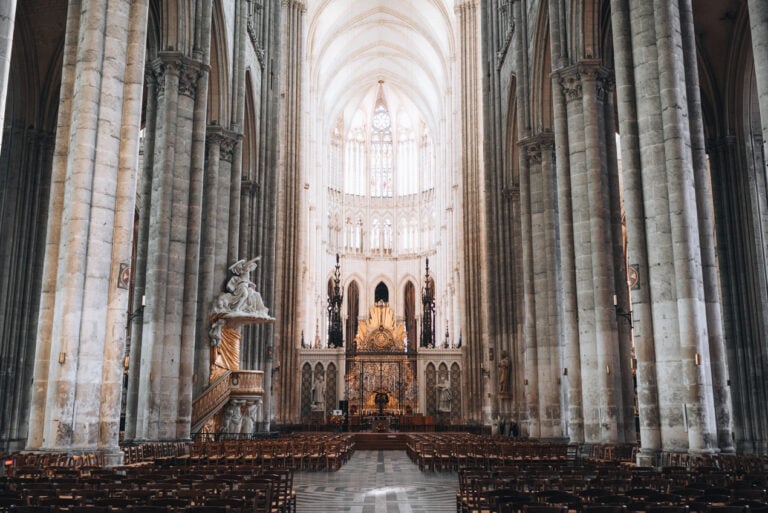
If Strasbourg’s cathedral wins me over with detail, Amiens wins on sheer scale. This is the largest cathedral in France by interior volume; big enough to fit two Notre-Dame de Paris cathedrals inside.
The first time I walked in, I actually laughed at how small the other visitors looked beneath those vaulted ceilings. Photos really don’t prepare you for it.
The remarkable thing is that this Gothic giant went up in just about 50 years, starting in 1220, which gives it an unusual sense of unity. Most cathedrals of this size took centuries and ended up a patchwork of styles. The western façade is full of carved sculptures, and the high rose window is breathtaking.
It’s a UNESCO World Heritage Site, and rightfully so.
My favorite reason to recommend Amiens, though, is something you can only catch after dark on certain evenings of the year.
During the light show, projectors flood the façade with color, recreating the way these carvings would have been painted in medieval times. I stood in the square with a hot drink, completely mesmerized, surrounded by locals who clearly come back for it year after year.
Amiens is still off the tourist trail, and that’s a big part of its charm.
5. Cathédrale de Metz
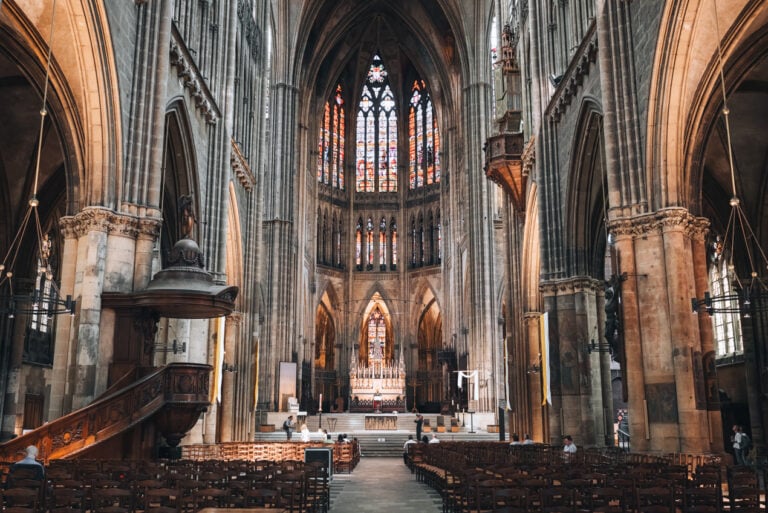
I saved Metz for last because it tends to surprise people. This is one of the most underrated French churches, and it deserves so much more love than it gets.
Like Strasbourg’s cathedral, it took roughly three centuries to build, and it’s a stunning example of Gothic architecture. But its real claim to fame is glass.
The Cathédrale de Metz has one of the largest expanses of stained glass in the world. And when the sun hits those windows, the whole interior floods with color.
But what makes Metz extra special is the mix of eras represented in the glass.
You’ll find medieval windows sitting alongside modern panels designed by Marc Chagall.
I remember standing there, looking from a 700-year-old window to a 20th-century one just steps away, and thinking how rare it is to feel that whole sweep of time in a single room.
Metz sits in the Lorraine region, and it doesn’t see nearly the crowds of Paris. That’s exactly why I love sending people here. You can often have a quiet moment beneath that soaring, jewel-toned ceiling, with no one rushing you along.
Summary
So, how many churches are in France? The most honest answer is somewhere between 42,000 and 45,000 Catholic churches, and even more once you count the chapels, basilicas, and historic religious buildings tucked into every corner of the country.
There’s no single tidy number, and after living here since 2012, I’ve come to love that about France.
Here’s what all those years as a resident have taught me: the magic was never in the count. It’s in the discovery.
Sure, the famous cathedrals like Reims, Amiens, and Sainte-Chapelle will take your breath away. But some of my most unforgettable moments happened in tiny village churches I stumbled upon by accident. That’s the France I fell for, and it’s the France I love helping other travelers find.
So next time you’re wandering these streets and lanes, look up. Follow that spire down a quiet side road. You might discover your own favorite corner of this beautiful, church-dotted country.
And if you’d like a little help getting there? I’d love to chat. Book a call with me, and let’s map out your itinerary together.
Read More Articles About France
Hope you enjoyed my post and found it useful. Here are some other articles that I think you might find interesting.
- A Local’s Guide to Getting Around France without a Car
- 19 Useful Apps and Websites for Traveling in France
- Do French People Like Americans? A Surprising Answer!
- Why I Love France: 11 Reasons to Fall Head over Heels
- The Ultimate 10-Day Eastern France Itinerary by Train
- The Perfect 5-Day Northern France Itinerary
