Lyon is one of my favorite cities in France for a weekend trip. It has the grand architecture and history you’d expect from a major French city, but it also feels much more approachable than Paris.
You can spend the morning wandering medieval lanes in Vieux Lyon, climb up to Roman ruins and one of the city’s best viewpoints by lunch, and end the day with a long bouchon dinner and a glass of Côtes du Rhône.
I’ve been living and traveling in France since 2013, and I’ve visited Lyon several times over the years, mostly for long weekends.
Some trips were focused on sightseeing, others were about food, wandering neighborhoods, and revisiting favorite spots. After all those visits, I’ve figured out which attractions are worth prioritizing and which ones you can skip.
In this guide, I’m sharing my favorite things to do in Lyon, from can’t-miss sights like Vieux Lyon and Fourvière Basilica to food markets, viewpoints, traboules, museums, and a few more local-feeling spots I’ve loved on repeat visits.
This post contains affiliate links, meaning I may earn a commission if you make a purchase by clicking on a link (at no extra cost to you). Disclosure Policy
1. Track Down Lyon’s Traboules

Who doesn’t love exploring hidden passageways?
Well, Lyon is full of secret alleys called traboules.
They connect streets, buildings, courtyards, and even entire neighborhoods!
While they have always been a part of the city, their most significant use came during World War II.
Locals used the traboules to move from one neighborhood to another completely undetected. This allowed them to build resistance groups and outsmart their opposition.
Today, you can visit the remaining traboules, but you’ll need to use your treasure-hunting skills or a good map to find them. Most are tucked away behind unassuming doors or staircases, making them easy to miss.
To help get you started, here are the most famous traboules in Lyon:
- Cour des Voraces: 9 Place Colbert
- The Longest Traboule: 54 Rue Saint-Jean and 27 Rue du Bœuf
- La Tour Rose: 22 Rue du Bœuf
It took me more than an hour to find the entrance to each one of these. The numbers on the buildings were not clearly visible.
For the Longest Traboule, I had to open a door that looked like someone’s apartment, which was scary (but worth those five seconds of feeling awkward).
If you’re here in Lyon for only a day, pick one to visit. I recommend the Longest Traboule because it’s the easiest to find.
2. Go Viewpoint-Hunting

Lyon has some of the best city views I’ve found anywhere in France, and I made it my mission to track down every single one.
I mean that literally: I walked to every viewpoint on Google Maps and found a handful of extras that didn’t appear anywhere online.
My top picks are:
- Jardin des Curiosités is the best overall viewpoint, and the one I’d send every first-time visitor to. The panorama over the Saône and Presqu’île is hard to beat.
- Belvédères des Jardins du Gros Caillou is the one to seek out if you want a quieter, more local-feeling spot with surprisingly wide views and almost no crowds.
- Point de Vue along Rue des Fantasques is the one I’d save for sunrise or golden hour specifically. The light hits the rooftops at an angle that makes the whole city look like a painting.
3. Walk Around Vieux Lyon (Old Town)
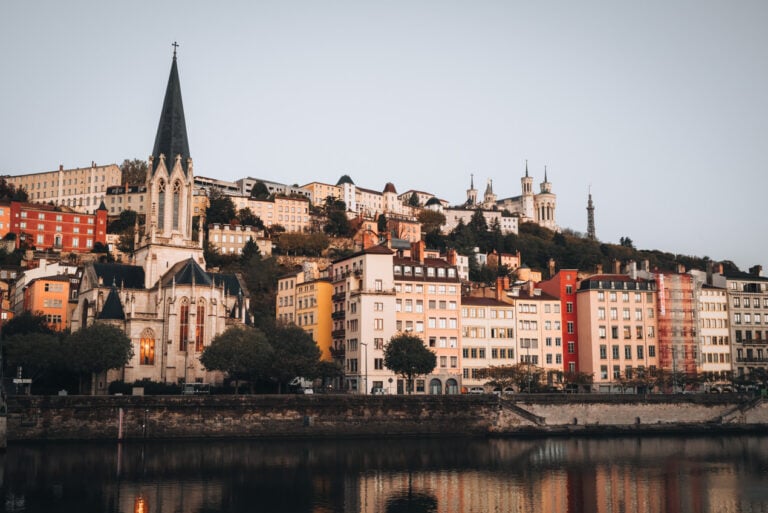
As the oldest district in Lyon, a stroll through Vieux Lyon is like taking a step back in time. And, if it’s your first time in Lyon, this is where I’d start.
Here you’ll find stunning architecture, charming alleys, and old-world ambiance.
In fact, the colorful Renaissance mansions that line the narrow streets are one of the reasons why this area is a UNESCO World Heritage Site.
I walked up and down every street several times. I kept finding a new building or shop I wanted to visit. The most picturesque part was along Quai Fulchiron.
And there’s no wrong time to visit Vieux Lyon. In the morning, I had the place to myself and felt very safe.
Even if the afternoons were crowded, it gave life to the area.
4. See Lyon’s Famous Frescoes

Lyon is dotted with enormous outdoor murals that are unlike anything else I’ve seen in a French city.
These trompe-l’œil frescoes were commissioned by CitéCréation and together form what’s known as Lyon’s Open-Air Gallery, a collection of 30 wall paintings that each tell a different piece of Lyon’s history.
But the most impressive feature is their size. These murals are so gigantic that they look lifelike.
The ones you won’t want to miss are:
- Mur des Canuts: 36 Boulevard des Canuts
- Fresque des Lyonnais: 2 Rue de la Martinière
- Bibliothèque de la Cité: 6 Rue de la Platière
When I walked past the Bibliothèque de la Cité mural, I thought it was an actual library at first. That’s how real these paintings are.
If you’re in Lyon for three days, try to see them all.
5. Explore Lyon’s Roman Ruins

Most people don’t expect to find real Roman ruins in Lyon, but they’re here, and they’re impressive. The city was originally founded as Lugdunum in 43 BCE, and it grew into one of the most important cities in the western empire.
Forums, theaters, and aqueducts were built to accommodate its prosperity.
Today, many of these structures are still intact.
While there are lots of excavation sites in Lyon, the most impressive are on Fourvière Hill.
The main sites, the Théâtre Gallo Romain de Lyon-Fourvière, the Odeon of Lyon, and the Thermes Antiques de Lyon, are all clustered together on Fourvière Hill.
Best of all, admission to all three sites is completely free.
But if you want more details about this part of Lyon’s past, I recommend visiting the Lugdunum – Musée et Théâtres Romains. It’s next to the Théâtre Gallo-Romain de Lyon-Fourvière and took me about an hour to visit.
6. Marvel at the Fourvière Basilica

Next to the Romain ruins on Fourvière Hill is the beautiful Fourvière Basilica.
Its mosaic-lined ceiling and its pristine white exterior are the most notable features. In fact, its outer walls are so bright you can see the church from anywhere in Lyon.
In the afternoon, when the sun hits the rose windows, the altar outshines all else. It’s easily one of the most impressive churches I’ve been to in the country.
If you combine the Romain ruins and this basilica, it will take about half a day to visit everything. It took me longer because I got lost exploring some of the side streets, so make sure to have Google Maps on your phone.
7. Eat at Les Halles de Lyon Paul Bocuse
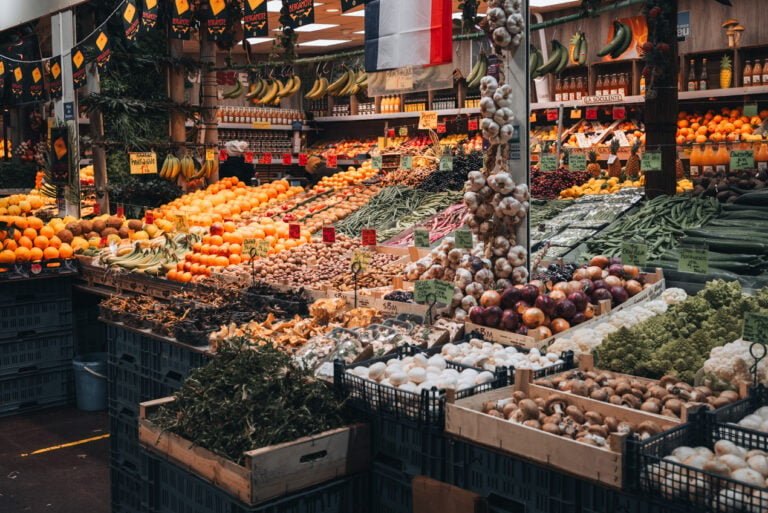
If you only do one food stop in Lyon, make it Les Halles de Lyon Paul Bocuse.
This legendary indoor market hall has been the city’s culinary heartbeat since 1859, and a single visit is enough to understand why Lyon has earned its reputation as the gastronomic capital of France.
The stalls are packed with some of the best local produce you’ll find anywhere: aged cheeses, paper-thin charcuterie, praline tarts, fresh oysters, and glossy pastries that will make you stop walking.
I’d go hungry and plan to graze your way through rather than rushing it.
8. Visit the Cinema and Miniature Museum

This is one of my favorite museums in Lyon, and I’d recommend it even if quirky museums aren’t usually your thing.
The Musée Cinéma et Miniature is packed with film props, costumes, and incredibly detailed miniature scenes that show you exactly how movie magic is made.
I’ll be honest, I’m a total wimp when it comes to horror, so the alien and creature effects sections scared me, even with the warning signs posted outside.
But once I got past that, I was completely absorbed.
It’s a great museum for anyone who wants something a little different from churches and squares. Budget a solid hour and don’t rush through it.
9. Discover La Croix-Rousse

La Croix-Rousse has a character all its own, part working-class history, part bohemian present, with a strong local identity that makes it different from the more polished neighborhoods down the hill.
This is where Lyon’s legendary silk workers lived, and you can still feel that vibe in the bookshops, street art, morning markets, and the fact that locals here seem to outnumber tourists by a healthy margin.
The most rewarding way to explore it is on foot with no particular plan.
Start at Montée de la Grande-Côte, one of the steepest and most colorful streets in Lyon. From there, wander until something catches your eye, a café spilling onto the pavement, a mural on a side wall, a boulangerie worth ducking into.
Then, finish your visit in Jardin du Gros Caillou. It’s a lovely spot to sit and watch locals go about their day.
Croix-Rousse tends to appeal most to travelers who like neighborhoods over monuments, so if that sounds like you, build in a full morning here rather than just a quick detour.
10. Visit the Parc de la Tête d’Or

When the constant up and down of Lyon’s hilly streets starts to wear you out, Parc de la Tête d’Or is the perfect place to take a breather.
It’s enormous, and I spent an entire morning just wandering from one garden to the next.
My two favorite spots were the International Rose Garden and the Madagascar Greenhouse, both of which are a dream if you love photographing flowers and plants.
It’s free to enter, open year-round, and lovely in spring and summer when the gardens are in full bloom. Plan to spend at least an hour, more if you like to wander slowly.
11. Shop at a Weekly Market

Shopping at local markets is something I do in every French city I visit, and it’s one of the many things I love about France.
In Lyon, especially, the markets are worth seeking out for more than just atmosphere. They’re one of the best places to pick up picnic supplies like fresh bread, local cheese, charcuterie, and seasonal fruit.
The prices are also more reasonable than anything you’ll find in a grocery store.
There are quite a few markets in Lyon, but my favorite was the Marché Saint Antoine along Quai des Célestines. It gets crowded toward the afternoon, so be sure to get there early.
Where to Stay
For most first-time visitors, I’d recommend staying in either Vieux Lyon or Presqu’Île. Both neighborhoods put you within easy walking distance of the city’s best attractions, and neither requires you to rely heavily on public transit to get around.
Vieux Lyon is the more atmospheric of the two, but Presqu’Île is better if you want to be central to everything.
Below, I’ve compiled a list of the best hotels in both neighborhoods:
- Villa Florentine: Located in the center of Vieux Lyon, this amazing hotel offers some of the most spectacular views. They also have a 24-hour reception and air conditioning for those hot summer nights.
- InterContinental Lyon – Hotel Dieu, an IHG Hotel: Located in Presqu’Île, this hotel is all about amenities. They have everything from currency exchange to concierge services.
- Hotel Le Royal Lyon – MGallery: Another wonderful hotel in Presqu’Île. The beds are comfy, and the staff is helpful. There’s even a restaurant where you can take cooking classes.
Where to Eat
Lyon takes its food seriously, more seriously than almost anywhere else I’ve been in France.
Traditional bouchons are the best places to eat. They’re old-school Lyonnaise bistros that have been around for centuries, and they’re as much about the atmosphere as the food.
All four of the bouchons below have earned the official label and are worth your time — but if I had to send a first-timer somewhere, I’d start with Daniel et Denise or Le Bouchon des Cordeliers:
What I’d Prioritize
Lyon is one of those cities that gets better the more time you spend wandering it. Yes, the big sights like Vieux Lyon, Fourvière Basilica, and the Roman ruins are worth seeing.
But some of my favorite moments in the city have been much simpler: getting lost in traboules, walking up to Fourvière instead of taking the funicular, or tracking down a new viewpoint just to watch the light hit the rooftops.
If it’s your first time in Lyon, I’d focus on a mix of the city’s historic highlights and its food scene: Vieux Lyon, Fourvière, a bouchon dinner, and at least one long walk through Croix-Rousse. That combination gives you a really good feel for what makes Lyon special.
I hope this guide helps you plan your trip and narrow down what’s actually worth your time. If you’re still deciding how to organize your visit, book a travel planning consultation call with me.
Read More Articles About France
I hope you enjoyed my post and found it helpful. Here are some other articles that I think you might find interesting.
- 13 Most Underrated Cities in France to Visit
- A Local’s Guide to Getting Around France without a Car
- Do French People Like Americans? A Surprising Answer!
- The Ultimate 10-Day Eastern France Itinerary
