When I left the US, I vowed that I would never own a car again.
I thought it was too expensive, and since I was moving to France, I knew it would be much easier to take public transportation or ride my bike.
Fast-forward to 2019, when I moved from Paris to Strasbourg, and that statement still holds.
I use public transportation and my legs to get around Strasbourg, but when I want to visit other places in the region that aren’t accessible by either of those, I rent a car.
So far, I’ve rented a car in Strasbourg six different times.
In this guide, I’ll cover how to rent a car in Strasbourg, including which companies are the best to rent from, cost-saving tips, and other practical advice.

Please note: This post contains affiliate links, meaning I may earn a commission if you make a purchase by clicking on a link (at no extra cost to you). Privacy Policy.
Why Strasbourg?
I often get questions in my Facebook group, Alsace Travel Tips, about renting cars in Alsace.
Most people want to know which city is the best.
And my answer EVERY SINGLE TIME is Strasbourg.
Why?
It’s cheaper, and there are lots of companies to choose from.
Smaller towns like Colmar don’t have many options, and picking up or dropping off a rental car on weekends or public holidays is nearly impossible.
If you’re basing your stay in Colmar, you’re better off taking a 30-minute train to Strasbourg to rent a car and drive back to Colmar.
Where to Rent a Car
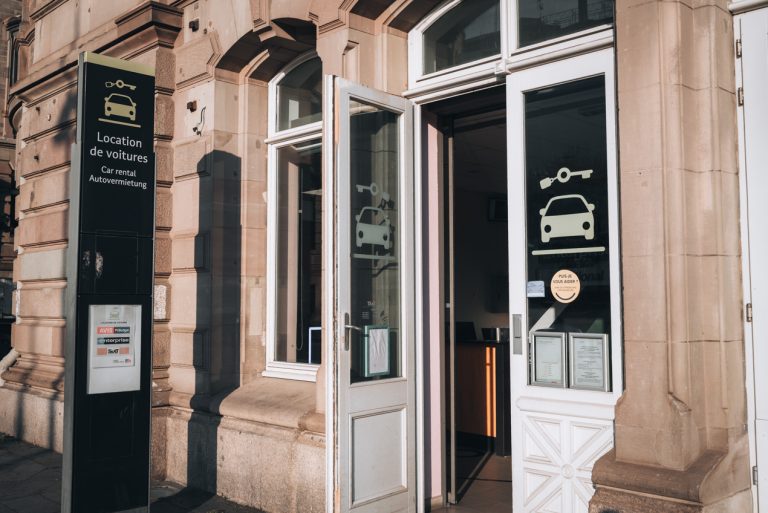
There are two car rental locations in Strasbourg:
- Strasbourg’s Train Station (Gare de Strasbourg) is in the center of the city and easily accessible. (Address: Place de la Gare, 67000 Strasbourg)
- Strasbourg’s Airport (SXB) is outside the city (20 kilometers, 12 miles). From Strasbourg’s Train Station, trains to and from the airport are frequent and take 25 minutes. (Address: RM 221/Route de l’Aéroport, 67960 Entzheim)
Every time I have rented a car, I have done so at Strasbourg’s main train station. Car rentals are much cheaper than those at the airport.
Car Rental Companies in Strasbourg
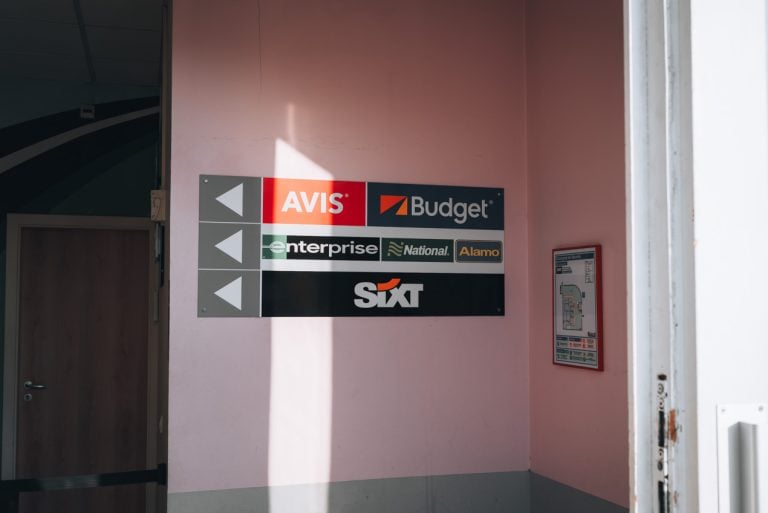
The car rental companies that are available are:
- Avis
- Budget
- Enterprise
- Alamo
- Hertz
- Sixt
Then, there are online booking platforms like Discover Cars, Rentalcars.com, and Thrifty.
So, I will start by saying that the customer service at all these rental companies isn’t great.
I have had several companies try to scam me by charging me for scratches that were there before I rented the car.
Luckily, I always take photos and videos, so I could dispute their claims.
I have found the best option is to rent with Discover Cars and choose Sixt.
Why?
Discover Cars has the best price, and Sixt is open when the other agencies are closed.
I also like that Discover Cars offers free cancellation, so if my plans change, I can always cancel.
Helpful Tip: They usually highlight the last date and time you can cancel for free.
Requirements
For anyone renting a car, a driver’s license and a passport are mandatory.
An international driver’s license in Strasbourg, or in France for that matter, isn’t required by law. But again, there are exceptions.
For non-EU tourists, an International Driving Permit (IDP) is required, IF your driver’s license is NOT in English.
That means an American with a US driver’s license can drive in Strasbourg (and in France) without an International Driving Permit (IDP).
If you plan on crossing borders and driving in a neighboring country (like Germany or Switzerland), you might need an IDP.
For Americans, you can get an IDP at the American Automobile Association. It costs about $20 plus a passport photo fee.
Types of Cars for Rent
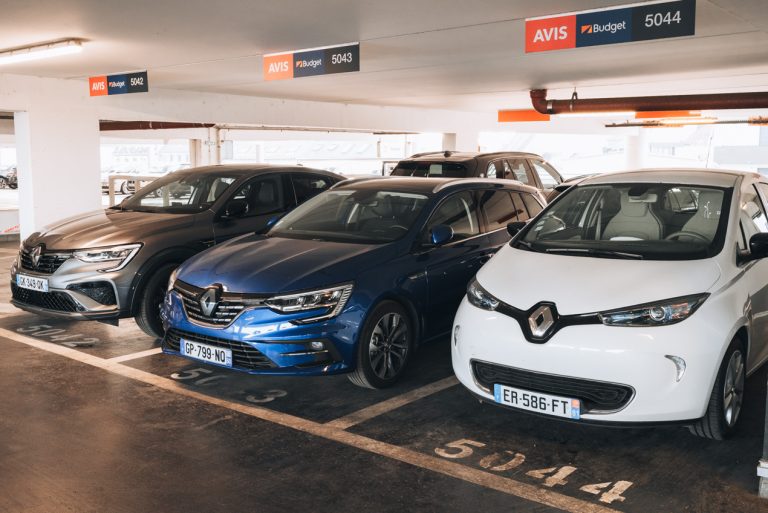
You’ll find a wide variety of cars to rent, but, for most people, economy and family-sized cars are the best options.
These are the types of cars I have rented. They are big enough to hold a small family with luggage, but not so big that they can’t fit into tiny parking spaces.
If you’re traveling with a large group, there are luxury cars and vans, although they are usually far more expensive to rent.
Then, within each type of car, there is an option to rent electric, hybrid, automatic, or manual cars.
I recommend going with a hybrid automatic car (if you’ve never driven a manual car).
That’s what I have done on my last three rentals. I saved money on gas and didn’t have to deal with driving a manual car, which I can’t do.
Average Cost
Renting a car in Strasbourg will cost €80-140 a day, depending on the type of car and the pick-up and drop-off dates.
Below is a list of other costs that you should take into consideration:
- Gas Prices: Gas (or petrol) prices in France aren’t cheap.Currently, gas costs about €1.68 per Liter in Strasbourg. Hybrid and electric cars will save you some money on gas, and there are charging stations all over Alsace (and France).
- Automatic vs Manual: Automatic cars are more expensive to rent than manual cars. But that is starting to change. Now, you’ll see more options for automatic cars than manual, and the difference is usually not more than €10 a day.
- One-Way Rentals: There’s an extra fee for one-way car rentals. For example, if you want to rent a car in Strasbourg and then drop it off in Paris, you’ll pay €160 in extra fees.
- Cross-Border Travel: Check if cross-border travel is allowed and if there are any additional fees. I had to pay an extra fee for crossing into Spain from France.
Driving In and Around Strasbourg
Below, I’ve listed what you’ll need to know before driving in Strasbourg, Alsace, and the rest of France.
- Right on Red is Illegal: Unlike in the United States, it’s illegal to make a right turn at red lights in Strasbourg and the rest of France.
- Learn the Street Signs: Street signs will undoubtedly be different from those in your home country. So, before you start driving, research the meanings of the most common signs.
- Know How to Pass: It’s illegal to use the right lane (slower lane) for passing. If you encounter a slow-moving vehicle, move into the left lane to pass, then back into the right lane.
- Learn How to Use a Roundabout: There are a lot of roundabouts. In fact, they’re more common than 4-way and 2-way intersections.
- Look for Motorcycles: Motorcyclists can be very aggressive. They have the right to drive between cars, even on the highway.
- Wear a Seatbelt: Seatbelts are mandatory. If you’re caught not wearing a seat belt, fines can be upwards of €150.
- Look for Emergency Vehicles: Emergency vehicles always have priority over other road users. If you hear sirens or see flashing lights, move to the right and slow down.
- Obey Speed Limits: The speed limit changes when visibility is hindered. Be aware that signs are not always posted to remind you.
- Highway: 130 km/h in normal conditions, 110 km/h in rain
- Inner City Highway: 110 km/h in normal conditions, 100 km/h in rain
- Other Roads: 90 km/h in normal conditions, 80 km/h in rain
- Urban Areas: 50 km/h in all conditions.
- School Zones: 30 km/h in all conditions
Extra Tips
Here are a few extra tips that have helped me:
- Choose a Compact/Economy Car: Parking in Strasbourg (and Alsace) is limited. So, having a small car that can squeeze into tiny spots will make a huge difference.
- Thoroughly Inspect the Rental Car: Take pictures (and videos) of every scratch, nick, and smudge on the car. Make sure to capture all the damage BEFORE you leave.
- Speed Traps: Automatic traffic cameras are used to enforce the speed limits. If you do get caught speeding, you’ll see a huge flash and get a ticket mailed to you.
- Tolls are Expensive: Toll roads in France are expensive. As an example, when I drove from Strasbourg to Paris, I paid about €60 in tolls. If you don’t want to pay, I recommend taking a route that avoids toll roads.
- Tolls Accept Debit/Credit Cards: There are three ways you can pay tolls. You can pay cash, use your credit/debit card, or use an automatic pass (most rental cars don’t have one).
- Know the Phone Number of Your Car Rental Company: You should get a document that has all the numbers for roadside assistance. But, if you don’t, make sure to note the number to call in case of a breakdown.
- Download a Parking App: Paybyphone, Flowbird, and EasyPark are three apps that you can use to find parking spots and pay for parking. They work all over Strasbourg and Alsace.
- Navigation: Google Maps, Waze, and Maps.me work in France, and those are the apps I use when I am driving. They are the most up-to-date for speed limits and speed traps.
Conclusion
Choosing to rent a car in Strasbourg is simple. There are lots of companies available, and the process is hassle-free.
But picking the right rental company can make the difference between a fun vacation and a headache.
I use and recommend Discover Cars. Then, if you follow the tips and suggestions in this guide, you’ll be sure to have an amazing road trip.
Read More Articles
I hope you enjoyed my post and found it helpful. Here are some other articles that I think you might like.
- 25 Amazing Things to Do in Alsace (Local’s Guide)
- A Local’s Guide to Getting Around Alsace
- Where to Stay in Strasbourg: Best Areas and Hotels
