You land at Charles de Gaulle, jet-lagged and buzzing with excitement, and then it hits you—every French phrase you practiced on the plane suddenly vanishes from your memory.
Do you actually need to speak French to order a coffee, ask for directions, or check into your hotel? Or can you get by with English and a hopeful smile?
If you’re planning a trip to Paris, or thinking about moving there, this is probably one of the questions keeping you up at night.
And after living and working in Paris for three years, learning French from scratch, and eventually earning my French citizenship in 2024, I can promise you the answer is a little more nuanced than most guides let on.
Here’s the short version: French is the main language in Paris, but it’s far from the only one you’ll hear.
Below, I’ll walk you through the languages spoken in Paris, whether you need French to survive, how to handle the Paris language barrier with confidence, and a few simple phrases that’ll help you feel at home from day one.
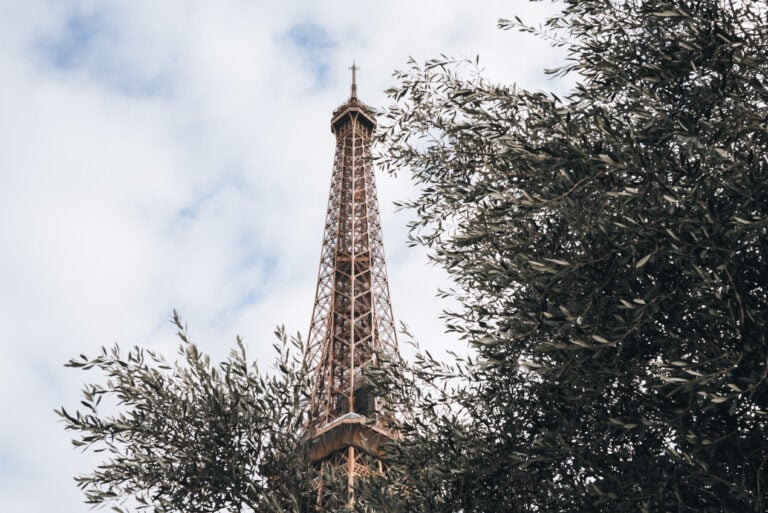
So, What Do People Really Speak in Paris?
There’s no denying that Paris is a wildly popular city for expats and tourists alike. The food is delicious, the sights are spectacular, and who can resist a summer stroll along the Seine? But what about the language? What language do they speak in Paris?
French is the main language, but it’s not the only one you’ll hear. English, Spanish, German, Italian, Portuguese, and Chinese are all fairly common too, especially among expats and tourists.
That said, your day-to-day experience depends a lot on where you are. Tourist zones, international workplaces, and expat circles will feel far more multilingual than a tiny neighborhood bakery.
If you’re visiting Paris for the first time this summer, it’s always worth picking up a few basic French phrases before you go. They’ll help you get around the city, order food at non-touristy restaurants, and connect with locals on a more personal level.
How Much French Really Matters in Paris
You don’t strictly need to speak French in Paris.
But should you speak French in Paris? That’s an entirely different question.
In my opinion, absolutely yes. Learning even a little of the language is one of the best ways to experience a place. It’s fun, it deepens your understanding of the culture, and it helps you connect with locals in a way English simply can’t.
As a tourist, not speaking French won’t ruin your trip. But as someone who lived there, I noticed that even basic French opened doors socially. Everyday moments felt less transactional and more human, whether I was chatting with a cashier, waving hello to a neighbor, or figuring out what was happening around me.
And if you’re wondering, can you live in Paris without speaking French? Technically, yes. But it makes life harder. Renting an apartment, handling government paperwork, opening a bank account, and making friends beyond the expat bubble all get much smoother once French enters the picture.
What Happened When I Tried to Get Around in English
Yes, you can get by speaking English in Paris. Plenty of expats and tourists speak it, and many locals in tourist areas are happy to help you out.
But here’s the honest, on-the-ground truth: it really depends on where you are. In tourist-heavy neighborhoods, hotels, and major attractions, English is usually enough. In smaller neighborhood bakeries, pharmacies, or local restaurants, things change fast.
I remember one of my first weeks in Paris, walking into a little bakery near my apartment and launching straight into English. The response was polite but cool. The next day, I tried again, this time opening with a warm “Bonjour,” and the whole interaction shifted. The woman behind the counter softened, smiled, and even helped me pick the perfect pastry. That tiny word made all the difference.
So while you can get by speaking English, I wouldn’t lean on it entirely. If you’re visiting on vacation, a few phrases will carry you a long way. But if you want to live abroad, you’ll need to be ready and willing to learn French.
The Kind of French You’re Most Likely to Hear in Paris
The Parisian accent is considered the standard French pronunciation, at least by Parisians. It’s so clean and clear that it’s the preferred accent for French textbooks, audio courses, and online lessons.
I remember the exact moment this clicked for me. All of my French tutors had a Parisian accent, so that’s the sound I trained my ear on. Then I started traveling around France and noticed the rhythm, pronunciation, and word choices shifting from region to region. Suddenly, I understood why Parisian French is treated as the “neutral” version everyone learns.
The funniest part came when I took the TEF exam for my 10-year resident permit. I was in Strasbourg, hundreds of miles from the capital, and the examiner giving my oral test had a crisp Parisian accent. Even far from Paris, that accent follows you around.
My Experience Learning French
Your ability to learn French depends on a few factors, the biggest being your native language and your prior experience with languages.
According to the Foreign Service Institute (FSI), French falls under category one, meaning it shares a lot of similarities with English and is relatively approachable.
That said, of the category one languages, French is the toughest. On average, the FSI estimates it takes about 30 weeks to reach working proficiency.
Having learned French myself, I’d say that’s pretty accurate. It took me around five months to feel conversationally proficient, and another two to feel completely fluent.
So why does it take so long? Two big reasons.
First, French grammar. The sentence structure is more layered than English, and it can feel overwhelming in the beginning.
Second, pronunciation. French words seem to break their own rules constantly, and half the letters appear to be silent.
Here’s the breakthrough that changed everything for me. Early on, I could recognize almost every French word on paper, but when people spoke quickly, it all blurred together into one long sound.
I was exhausting myself trying to translate each word in my head in real time. The moment I stopped translating and started listening for patterns instead – common phrases, sentence rhythms, familiar chunks – everything shifted. Conversations suddenly felt manageable.
Learning French wasn’t easy, especially at the start. But I never let that stop me, and neither should you. Push through those early challenges, and I promise you won’t regret it.
A Few French Phrases That Make Life Easier
Before you dive in, a quick note: these are the exact phrases that helped me most in everyday Paris life, especially in those nervous early days when I needed something simple but polite.
If you only memorize three before your trip, make them Bonjour, Merci, and Parlez-vous anglais? In Paris, politeness matters just as much as pronunciation, so a warm greeting goes a very long way.
- Hello / Good Morning: Bonjour (bown-zhoor)
- Hello / Good Evening: Bonsoir (bown-swahrr)
- Good-bye: Au revoir (OH-ruhv-WAA)
- Yes: Oui (Wee)
- No: Non (No)
- Please: S’il vous plaît (seel-vooh-pleh)
- Excuse me: Excusez-moi (ek-sku-ze-mwa)
- Thank you: Merci (mehr-see)
- Do you speak English?: Parlez-vous anglais? (pahr-lay vooz an-gleh)
- Where is the bathroom?: Où sont les toilettes? (oo-sohn leh twa-let)
What I’d Want You to Remember
French is the main language spoken in Paris, but it’s far from the only one you’ll hear. English is common in many tourist settings, and you’ll catch plenty of Spanish and other languages too. Still, even a little French can make your experience smoother, warmer, and far more rewarding.
If you’re visiting, learning a handful of basic phrases will boost your confidence and help you sidestep those awkward moments. And if you’re moving to Paris, making an effort with French will have an even bigger impact on your daily life, your friendships, and your sense of belonging.
Here’s what I want you to remember most: you don’t need perfect Parisian French to have a wonderful time. You just need a willingness to try.
When I first arrived, I was scared and stumbling over every sentence. A few years later, I was standing in an office being granted French citizenship. If I could get there, you can absolutely handle a bakery order or a hotel check-in.
And if you’re preparing for a trip or a move to France and want more personalized guidance, feel free to check out my travel consultations. Sometimes a little practical advice before you arrive makes the whole adventure feel far less intimidating.
Read More Articles About France
I hope you enjoyed my post and found it helpful. Here are some other articles that I think you might find interesting.
- Is Paris an Island? Did It Used to Be an Island?
- 13 Most Underrated Cities in France to Visit
- A Local’s Guide to Getting Around France without a Car
- 19 Useful Apps and Websites for Traveling in France
- Do French People Like Americans? A Surprising Answer!
- I Love France: Why This American Expat Never Wants to Leave
