I sat in the Hemicycle during plenary week with a headset over my ears, switching between interpretation channels and listening to the same speech in English and French. All around me, people moved in and out of the chamber, voices overlapped in the hall, and the whole building had a kind of momentum that caught me off guard.
My first thought was simple: Only in Strasbourg.
As a science nerd and an American who grew up far from the European Union, I went in expecting a dry civics lesson. Instead, I walked into one of the most interesting visits I’ve had in Strasbourg.
It gave me a much clearer understanding of why this city matters, why it was chosen as a seat of European democracy, and why a visit here adds something important to a trip that might otherwise focus only on canals, half-timbered houses, and the cathedral.
I’ve lived in Strasbourg since 2019, became a French citizen in 2024, and have visited the European Parliament more than once, both during plenary week and outside of it. I’ve also passed it from the water on Batorama’s tours, which gave me yet another perspective on how striking the building is.
In this guide, I’ll walk you through what the free visit includes, the difference between visiting during plenary week and outside of it, the ID mistake that gets people turned away, how to get there, and whether it deserves a place in a short Strasbourg itinerary.
My short answer? Yes, it’s worth it, especially if you enjoy learning about history, culture, and government.

At a Glance
- Cost: Free
- Open: Six days a week throughout the year.
- Time needed: About 1.5 to 2.5 hours if you want to see the Parlamentarium, the Hemicycle, and the viewing platform.
- Reservations: Not required for individual visitors.
- Must bring: A valid physical passport or national ID card.
- Best time to go: During plenary week if you want to see the Parliament in action.
- Languages: Information is available in the 24 official languages of the European Union.
- Best for: History buffs, curious first-time visitors, families, and anyone who wants to understand Strasbourg beyond the postcard version.
- Biggest mistake to avoid: Showing up with a driver’s license or a photo of your passport on your phone.
Why I Think It’s Worth Visiting
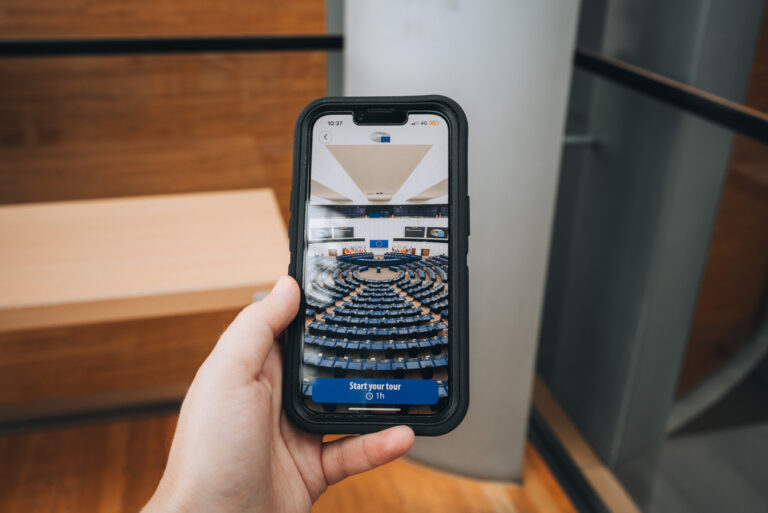
Strasbourg is one of those cities that makes more sense the longer you spend here.
At first, most people notice the postcard side of it: the cathedral, the canals, the half-timbered houses, and the cobblestone streets. But Strasbourg has another side, one that is tied to its history and its role in Europe today. That is part of what makes the European Parliament worth visiting.
If you have read my post on whether Strasbourg is in Germany or France, then you already know this city changed hands between the two countries several times. For centuries, Strasbourg sat at the center of conflict, shaped by both French and German rule in a way that still shows up in the architecture, food, and culture.
After World War II, that story began to shift. Instead of being a city fought over, Strasbourg became a symbol of cooperation and reconciliation. That is a big reason why several major European institutions were placed here, including the European Parliament.
I had run past the Parliament more times than I could count before that truly clicked for me. I knew it was important, of course, but it was not until I took Batorama’s Red Tour and started paying closer attention to Strasbourg’s European Quarter that I understood why these buildings belonged here.
The Parliament is the official seat of the European Parliament and the only directly elected institution in the European Union. It is also described as the world’s largest transnational parliament, which gives you a better sense of the scale of what happens here.
That is one reason I recommend visiting it.
The other is that it shows a side of Strasbourg many visitors miss. Most first-time trips focus on Grande Île, La Petite France, and the cathedral, which makes sense.
But if you stop there, you miss one of the most important parts of what Strasbourg is. The Parliament adds that missing layer.
I also like recommending it because it is free, indoors, and easy to pair with other stops nearby.
If you are visiting on a cold day, a rainy afternoon, or just want a break from walking through the old town, it is a smart addition to your itinerary. It also works especially well with Parc de l’Orangerie or a stroll through the Neustadt afterward.
Visiting During Plenary Week vs. Outside of It
If you are trying to decide when to visit the European Parliament in Strasbourg, this is the most important choice to make.
I have visited both during plenary week and outside of it, and the experience is different enough that it is worth thinking about before you plan your day.
Visiting During Plenary Week
Twelve times a year, Members of the European Parliament meet in Strasbourg for plenary sessions to debate and vote on legislation. This is when the Parliament is at its busiest, and if your dates line up, it is a very interesting time to go.
Visitors can watch the session from the public gallery, which gives you the chance to see the Parliament in action rather than just walk through it as a visitor site.
This is when my visit clicked the most.
The building was full of movement, voices, and different languages coming from every direction. Sitting in the Hemicycle with the headset on and switching between interpretation channels was one of the highlights of the whole experience. It gave me a much better sense of the scale of what happens here and why Strasbourg matters.
There is also something special about seeing the chamber being used for its intended purpose.
The pros of visiting during plenary week:
- You can watch live debates
- The building has more energy
- It gives you a rare look at democracy in action
The cons of visiting during plenary week:
- It is busier
- Photo rules are stricter in the Hemicycle gallery
- The schedule depends on the parliamentary agenda
- Limited opening times
My Tip: If you want to visit during plenary week, check the official calendar before booking your trip. The dates are set in advance, but they do not always line up neatly with a weekend itinerary.
Visiting Outside Plenary Week
Visiting outside plenary week is much calmer.
There is more room to take your time in the Hemicycle, move through the exhibitions at your own pace, and pause without people constantly filing past you. The visit is self-guided, with multimedia and audio information available.
I liked this version of the visit for different reasons, but mostly because I could go at my own pace and enjoy the exhibits.
The pros of visiting outside plenary week:
- Quieter atmosphere
- More flexible
- Easier for photos
- More space to linger in the Hemicycle and exhibitions
- Opening times are less restrictive
The cons of visiting outside plenary week:
- The chamber has less energy when it is empty
- You miss the chance to watch the Parliament in action
Which One I Would Choose
If your dates line up and you love politics, I would choose plenary week.
That is the version of the visit that stayed with me most. The live debates, the movement in the building, and the mix of languages gave the experience a weight that is hard to replicate when the chamber is empty.
That said, I would recommend visiting outside plenary week if you want a more relaxed visit.
Here is how I would break it down:
- First-time visitor: Outside plenary week
- Families with kids: Outside plenary week
- Photographers: Outside plenary week
- Politics and history buffs: During plenary week, no question
My Tip: Plenary weeks can also bring more people to Strasbourg overall, so if your trip overlaps with one, book your hotel early.
The Hemicycle
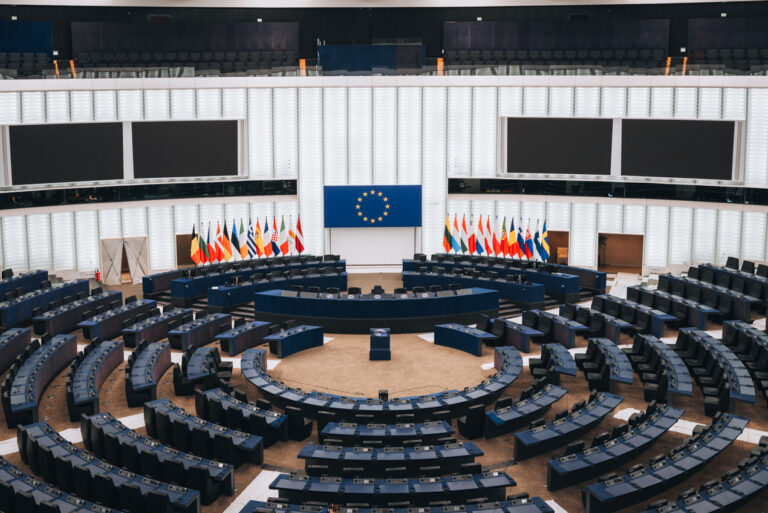
The Hemicycle was the part of the visit I had been most curious about, and walking into it for the first time did not disappoint.
The room is much larger than I expected. The rows of seats curve out in a wide semicircle, flags line the space, and above it all are the interpreter booths that make it possible for people from across the European Union to follow the same debate in different languages.
When I visited during plenary week, this was the moment that stayed with me most.
I sat there with the headphones on, switching between language channels and listening to the same speech in English and French. That alone was fascinating. It was one of those moments that made the whole visit click for me because it captured so much of what Strasbourg represents.
What surprised me most was how close the public gallery felt to the floor of the chamber. You are still clearly a visitor, of course, but you are close enough to watch the debates unfold.
If you visit outside plenary week, the hemicycle is very quiet. There were only a few visitors when I went. You have more time to sit, take photos, and follow the audio guide at your own pace.
For me, the Hemicycle was the coolest part. It is one thing to read about the European Parliament or pass the building on a boat tour. It is another to sit inside the chamber itself.
My Tip: Photos are allowed in the visitor areas, but not in the Hemicycle gallery during plenary sessions. If you want pictures, visit outside plenary week.
Why the Parlamentarium Simone Veil Is Worth Your Time Afterward
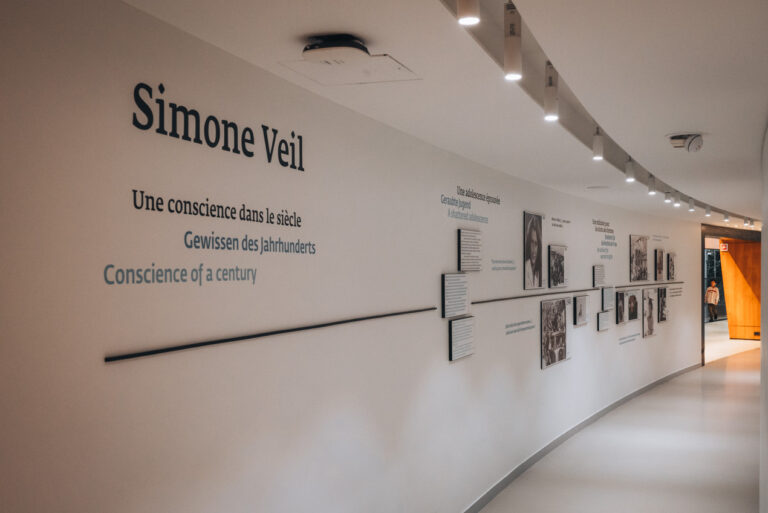
After the Hemicycle, the visit continues into the Parlamentarium Simone Veil, which works well because by that point you have already seen the chamber and have a better sense of what the exhibits are explaining.
This is the European Parliament’s visitor center, focusing on how European legislation works, what Members of the European Parliament do, and how EU policies shape daily life across the member states. It is named after Simone Veil, a Holocaust survivor and the first president of the directly elected European Parliament.
The visit is self-guided, and you move through it with an audio guide on your phone or on a device. There are also interactive exhibits along the way, including touchscreen tables and a 360-degree cinema. The audio guide takes about an hour, but there is quite a bit to stop and look at, so it can take longer.
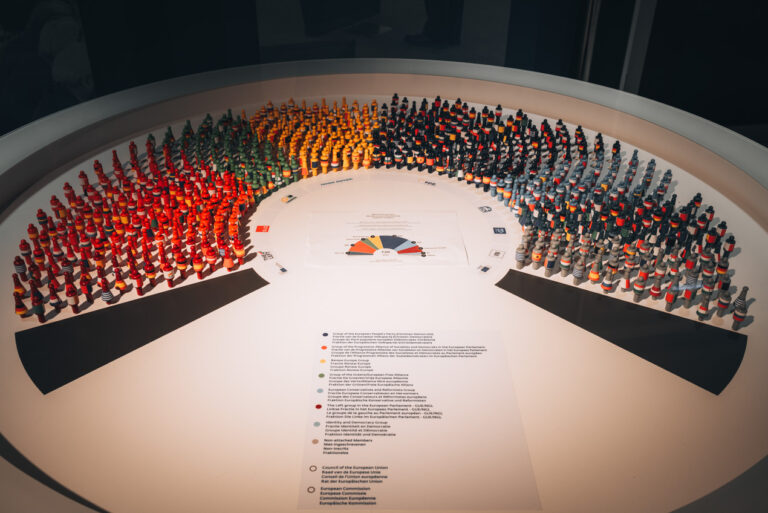
The section that stood out to me most was the one on the results of the European elections.
It was near the end of the tour, so by then I had a good understanding of how everything worked.
This particular exhibit showed how people across Europe voted and where different countries and political groups stand on major issues. It was a strong reminder of how much a vote matters.
My Tip: Even though the Hemicycle comes first on the route, do not rush through the Parlamentarium afterward. It gives useful context to everything you just saw.
Don’t Skip the Viewing Platform
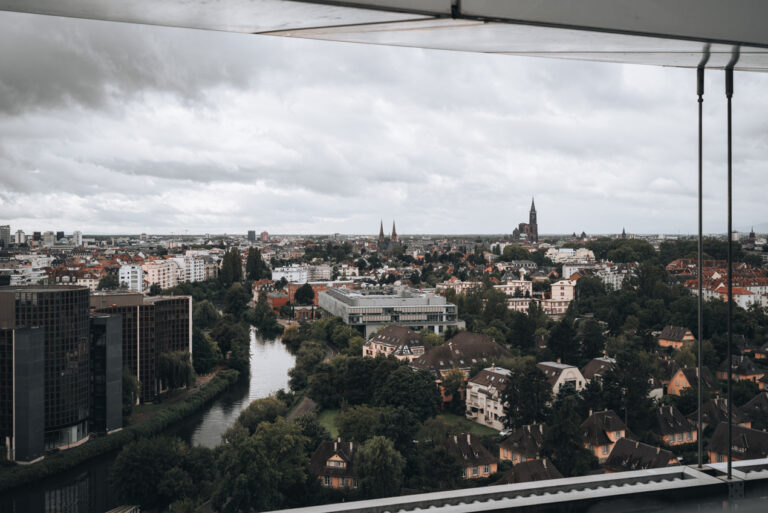
The viewing platform ended up being one of the most unexpected parts of my visit.
You can visit it before or after the rest of the tour, depending on the weather and how you want to pace your time. I ended up going last, mostly because it was raining when I arrived, and the platform was closed.
By the time I finished the visit, the rain had stopped, so I went up then, and I am glad I did.
From the top, you get a wide view of Strasbourg’s European Quarter and, in the distance, the cathedral’s spire. That is what I liked most about it. In one view, you can see both sides of Strasbourg at once: the modern, political side centered around the European institutions and the older skyline.
It is one of the more surprising views in the city because it is not the kind of panorama most visitors talk about. People usually focus on the cathedral platform, La Petite France, or the views from the Vauban Dam. But this one gives you something different.
If you get a clear day, it is well worth the extra few minutes. And if you visit in autumn, when the trees along the water turn gold and red, the view is even better.
Security and Entry Tips I Wish Everyone Knew
Before you go, there are a few rules you need to take seriously.
This is not the kind of attraction where you can show up unprepared and figure it out at the door. The European Parliament is free to visit, but the entry rules are strict, and if you miss one of them, your visit can end before it even starts.
- Bring a valid physical passport or national ID card. Photocopies, digital versions on your phone, and driver’s licenses are not accepted.
- If you registered in advance, bring the same ID document you used when booking.
- Do not bring large luggage. Suitcases, trolleys, and other large bags are not allowed inside.
- All visitors go through airport-style security. Bags are screened, and sharp objects, pepper spray, and anything that could be considered a weapon are prohibited.
- Photography is allowed in the visitor areas, but not in the security area or in the Hemicycle gallery during plenary sessions.
- Children under 14 must be accompanied by an adult.
- Only trained assistance animals are allowed.
My Tip: Make sure to visit the main website for the full list of rules, opening times, and schedules.
How I’d Fit It Into a Strasbourg Itinerary
I’d treat the European Parliament as a half-day stop rather than a quick visit, like I did in my two-day Strasbourg itinerary.
- Morning: Take the tram (Line E) to the Parliament and do the full visit: the Hemicycle, the Parlamentarium Simone Veil, and the viewing platform if the weather is clear.
- Afternoon: Walk over to Parc de l’Orangerie for a more relaxed stretch of the day.
- Late afternoon: Head back through the Neustadt and, if the timing works, stop by St. Paul’s Church around sunset.
- Evening: Finish the day with tarte flambée at Binchstub Broglie.
My Tip: Many museums in Strasbourg close one day a week, often Tuesday, so the Parliament can be a good backup plan — just check its schedule first.
Why I’m Glad I Went
The moment I still think about most is sitting in the Hemicycle with the headphones on, switching between interpretation channels and hearing the same speech move across languages. It was one of those experiences that felt very specific to Strasbourg.
That is why I would recommend the European Parliament to almost anyone visiting the city, especially first-time visitors who want to understand Strasbourg beyond the half-timbered houses and postcard views. It adds another layer to the city, and for me, it made the rest of Strasbourg make more sense too.
I also cannot say it hurt that, after getting a few related questions in my citizenship interview, I was very glad I had gone and learned a bit more.
If you go, the main things to remember are simple: bring your passport, check whether your visit lines up with a plenary week, and leave time for the viewing platform.
If you are planning a Strasbourg or Alsace trip and want help shaping your itinerary, I also offer one-on-one travel consultations.
Read More Articles About Strasbourg
I hope you enjoyed my post and found it helpful. Here are some other articles that I think you might find interesting.
- Best Time to Visit Strasbourg, France (Local’s Guide)
- Where to Stay in Strasbourg: Best Areas and Hotels
- What is Strasbourg Famous For? 17 of Its Best Kept Secrets
- My Experience Staying Safe in Strasbourg
- 21 Amazing Photos of Strasbourg to Ignite Your Wanderlust
