When I first arrived in Strasbourg in 2019, I wasn’t immediately swept away. It was a warm, sunny day in August, and when I stepped out of the train station, my first thought was that it looked like every other city I had seen in France.
Then I walked down Rue du Maire Kuss, nearly got hit by a bike, and made my way to my hotel tired and hungry. Later, I headed back out to explore and happened to walk down Rue Mercière. That was when I saw Strasbourg Cathedral for the first time.
I still remember that moment clearly. Seeing the cathedral rise up at the end of the street completely changed the way I saw the city. It was one of the coolest things I had ever seen, and from that point on, I wanted to know everything about Strasbourg.
I ended up moving here a few months later, and over the years, I’ve explored the city far beyond that first impression. I’ve visited the major sights, dug into the history, tested restaurants, and spent a lot of time figuring out what is worth doing and what can be skipped.
If you only have 2 days in Strasbourg, this is the itinerary I’d follow. It covers the big highlights, like the cathedral and La Petite France, but also includes the local tips and small details that make the city special.
Planning a trip to France and feeling overwhelmed?
Book a one-on-one consultation and get practical, firsthand help building an itinerary tailored to your travel style.
This post contains affiliate links, meaning I may earn a commission if you make a purchase by clicking on a link (at no extra cost to you). Disclosure Policy
Is 2 Days Enough?

Yes, two days is enough to see the main highlights and get a real feel for the city.
You won’t be able to see absolutely everything. Strasbourg is bigger than many people expect, and there is far more to do here than just wander around the cathedral for an afternoon.
But if you plan your time well, two days are enough to experience the places that make this city special and leave with a much better sense of Strasbourg than most visitors get.
Visit Strasbourg Like a Local
Turn your visit from a typical tourist trip into an insider’s experience with a printable version of this itinerary.

Day 1: Old-World Strasbourg and My Favorite Classics
Discover the Strasbourg Cathedral

The Strasbourg Cathedral was the moment Strasbourg really clicked for me. I had been in the city for maybe an hour, felt underwhelmed, and was still half-convinced it looked like every other place I had been in France.
Then I turned onto Rue Mercière and saw the cathedral at the end of the street. That changed everything.
It is easily one of the most impressive things to see in town, and even now, after years of living here, it still gets me. The scale of it is hard to explain until you are standing in front of it. Every part of the facade is covered in detail, and the closer you look, the more there is to notice.
Inside, the cathedral is just as dramatic, with stained glass, carved stonework, and the famous astronomical clock. If you don’t mind stairs, climbing to the platform is worth it too. There are more than 300 steps, but on a clear day you can see all the way to the Black Forest on one side and the Vosges on the other.
One thing I always tell people is not to stop at the main facade. Walk all the way around the outside. Some of the most interesting details are on the sides, especially near the clock entrance on the south side. That is also where you will find one of my favorite details on the cathedral: the statue of Sabine, which comes with its own local legend.
Go on a Treasure Hunt around Place de la Cathédrale
Place de la Cathédrale is easy to treat as just the space in front of the cathedral, but it is worth slowing down here. There are a lot of small details that most people walk right past, and a few of them tell surprisingly good stories about Strasbourg.
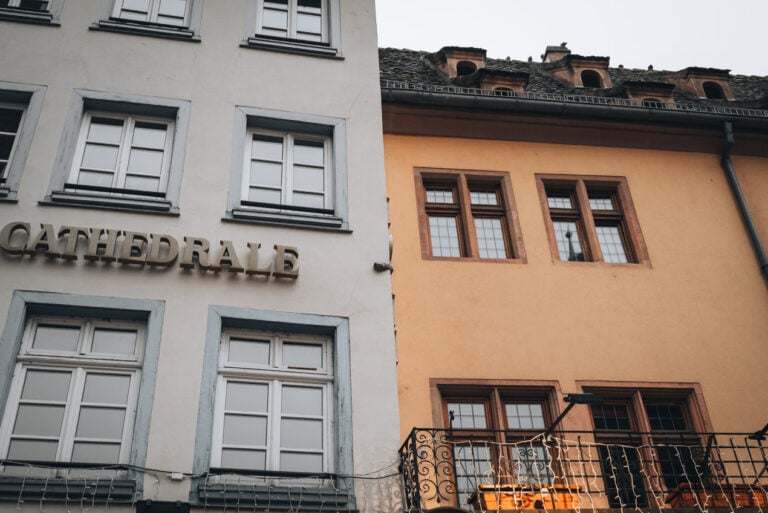
One of my favorites is at Hôtel Cathédrale.
Part of the building is painted white, and if you look closely at the corner, you can still see a deactivated bombshell from the Franco-Prussian War of 1870. It was left there on purpose as a symbol of resistance.
Another detail to look for is the hanging sign at 24 Place de la Cathédrale.
It shows the cathedral in gold and is topped with a red hat. During the French Revolution, the cathedral’s spire was seen by some as a symbol of inequality, and there was even a proposal to place a giant Phrygian cap on top to turn it into a symbol of liberty instead.
There is also Strasbourg’s time capsule, which is easy to miss unless you know to look down (Google Maps location).
It is marked by a bronze plaque in the square and was created by artist Raymond Waydelich in 1995. It is not supposed to be opened until September 23, 3790. Inside are letters, local food and drink, a Racing Club de Strasbourg football, and other objects meant to capture a snapshot of local life.
Take a Closer Look at Maison Kammerzell
Right next to the cathedral is Maison Kammerzell, one of the most recognizable historic buildings in Strasbourg. It dates to 1427 and is known for its detailed timber-framed facade, which is covered with carvings of musicians, religious figures, zodiac signs, and other decorative details.
Even if you do not go inside, it is worth stopping for a closer look. The exterior is one of those places where the more time you spend looking, the more you notice.
One example is the windows on the upper sections. They are made from small round panes known as bull’s-eye glass, an older technique used in the 15th and 16th centuries before large flat panes were possible.
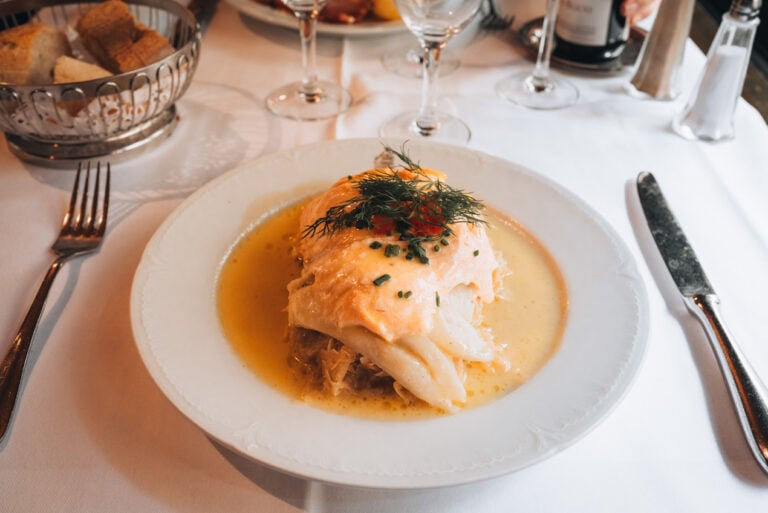
Today, the building is home to one of the best-known Alsatian restaurants. I went there for my first birthday in Strasbourg with my husband, and three fish choucroute is still one of the meals I remember most. We were seated by the window, with the cathedral just outside, and the whole setting was very Strasbourg.
If you want to eat here, book ahead. It is popular, and tables in the best spots tend to go quickly.
Explore the Musée Alsacien

When I wanted to learn more about the history of Strasbourg and Alsace, the Musée Alsacien was the first place I went. It’s still the museum I recommend most for understanding the region, and it’s one of my favorite stops in the city.
It’s set inside three connected half-timbered houses, and it focuses on what daily life looked like in Alsace during the 18th and 19th centuries. You’ll see traditional costumes, furniture, toys, pottery, and household items. What makes it worth your time, though, is how much it tells you about the people who lived here.
I loved learning about the little things, like how people dressed for different occasions, how their homes were set up, and the local traditions that shaped everyday life. Those details gave me a much better sense of Alsace than any big historical overview could.
I also went because I wanted to see the inside of a half-timbered house, and this is one of the only places in Strasbourg where you can really do that. You walk from room to room over creaky wooden floors and climb narrow staircases between levels. It made the history real in a way that standing in front of a display case never does.
My Tip: Many of Strasbourg’s city museums close one day a week (often Tuesday), so check the hours before you build your day around it.
Walk Around La Petite France

The first time I visited Place Benjamin Zix, I went in the afternoon. That was a mistake. The narrow streets were packed, the bridges were crowded, and it was hard to stop for even a second without getting in someone’s way. I left feeling a little disappointed.
So the next day, I set my alarm and went back early. This time, I had the place all to myself. The canals were calm, the streets were quiet, and I could finally take in the half-timbered houses without dodging tour groups. It felt like a completely different place.
That’s my biggest tip for visiting La Petite France: go early. It’s one of the most popular spots, and by late morning, it gets busy fast.
When I’m looking to capture some photos, I head to Pont Saint Martin or Pont du Faisan. Both give you beautiful views of the colorful buildings along the water.
Head Up to the Vauban Dam

The Vauban Dam is one of the more interesting historic landmarks in Strasbourg. Built in the 17th century, it was designed as part of the city’s defenses and could be used to flood the southern approaches during a siege.
The first time I tried to go up to the terrace, I assumed it would be open at sunrise and rushed over early in the morning. It was not open 24 hours a day, and I ended up awkwardly waiting around for the security guard to unlock it. I felt a little ridiculous at the time, especially because I had been hurrying to get there.
Still, I’d do it that way again. Morning is one of the best times to visit (no matter the time of year) because there are far fewer people, and the views are much calmer. From the top, you can look out over La Petite France, the Ponts Couverts, and the cathedral in the distance all at once.
Just don’t make my mistake and assume it is open all night like I did.
Day 2: Parks, Neustadt, and Beyond the Postcards
See Strasbourg’s European Side at the Parliament

Strasbourg has one of the most complicated histories of any city in France, and that is a big part of what makes it so interesting. Because of its location near the Rhine, Strasbourg went back and forth between France and Germany several times over the centuries. A lot of places in Alsace went through the same thing, which is one reason the region is so distinct from the rest of the country.
After World War II, Strasbourg took on a very different role. Instead of being fought over, it became a symbol of cooperation and reconciliation in Europe. That is why several major European institutions are based here today, including the European Parliament.
You can visit the Parliament for free. The Parlamentarium, its visitor center, gives a helpful overview of how the European Union works and why Strasbourg matters politically. It is more interesting than it might sound, especially once you understand the history behind it.
I visited during a plenary session week, which made the experience even better. The building was full of people speaking different languages, and there was a real sense of purpose to everything. Sitting in the hemicycle and listening to the same speech through different interpretations was one of those moments that made me think, “Only in Strasbourg.”
Before leaving, I went up to the viewing platform, which has one of the more unexpected views. From the top, you can look out over the city and even see the cathedral in the distance.
Take a Break in Parc de l’Orangerie

Just a short walk from the European Parliament is Parc de l’Orangerie.
Here you’ll find giant leafy trees, gorgeous gardens, and a beautiful lake. You can picnic on the lawn, rent a rowboat, or simply go for a walk. And if you’re visiting in spring, you’ll probably spot storks nesting high in the trees.
This park holds a special place in my heart. During my first spring in Strasbourg, I didn’t know many people yet. One Sunday, I packed a sandwich and planned to eat on the grassy area near the lake. I was in a quiet corner when a stork landed on the grass about ten feet from me. A little girl walking by squealed with joy, her grandmother started chatting with me, and I left the park that day feeling like I finally belonged here.
Now, it’s one of my favorite places to go walking on Sunday afternoons. It’s the busiest day, but there’s so much space that it never feels full. I particularly love the area in front of the Pavillon Joséphine. But the view from the Oeil d’Orangerie (the Eye of Orangerie) is my secret place.
Take a Stroll Through Neustadt
I first started exploring Neustadt when I was researching the history of Strasbourg for my VoiceMap walking tour.
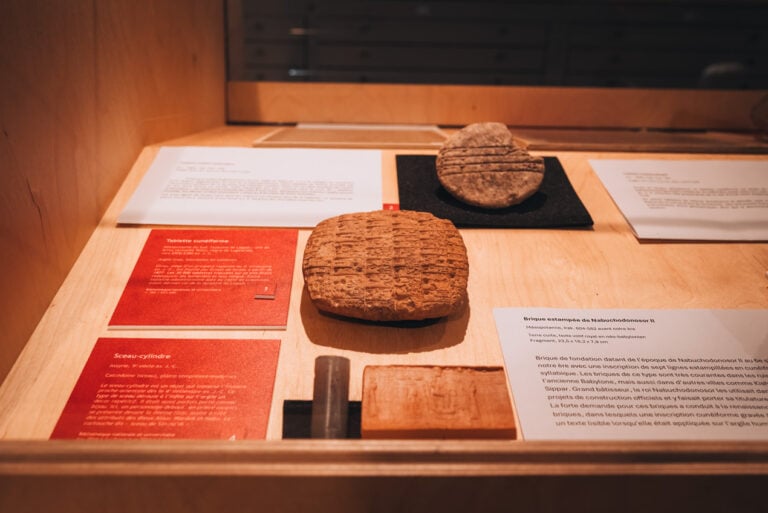
I began with Place de la République, photographing it in spring with the magnolias in bloom, then toured the rare collections at the National University Library of Strasbourg.
I remember thinking that if there was already so much history packed into this one square, what else was waiting to be discovered in this part of the city? That question sent me deeper into Neustadt, and it ended up opening my eyes to a whole different side of Strasbourg.
And since it was built under German rule in the late 19th and early 20th centuries, the buildings are very different from the rest of the city.
It’s a nice place to walk and appreciate the architecture, but if you have time, I recommend booking a tour of the National University Library of Strasbourg. It’s here you’ll find some of the rarest collections of books and artifacts in the country.
Devour a Madeleine du Voyage at Au Fond du Jardin
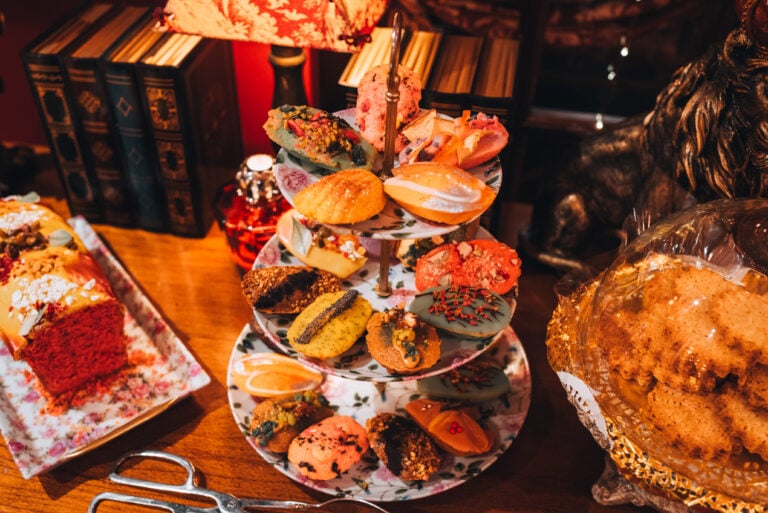
The first time I visited Au Fond du Jardin, I felt like I had stepped into a fairytale. The tearoom is tiny, beautifully decorated, and unlike anywhere else I’ve been in Strasbourg.
If you stop here, order a Madeleine du Voyage. These delicate little cakes are their specialty, and each one blends four different flavors into a single bite.
I ordered the Formule Dégustation on my first visit, and after hearing the staff describe each madeleine, I chose Victoria and Après La Pluie. Paired with tea, it ended up being one of the most memorable treats I’ve had.
Since that first visit, I’ve been back three more times: once with my mom, once with my aunt, and once simply because I couldn’t stop thinking about those madeleines.
My Tip: Reserve ahead if you want a table. If they’re full, stop by the boutique and grab a Madeleine du Voyage to go.
End Your Weekend with a Boat Tour

A boat tour on the Ill is a good way to end your visit. It is a more relaxing way to see the city, and it gives you a perspective on places like La Petite France that you just do not get on foot.
The main company is Batorama, and their boats have audio guides in several languages, which makes it easy if you do not speak French. I did the Red Tour with my Strasbourg City Card and thought it was worth it. The commentary was easy to follow, and I liked getting more historical context while seeing the city from the water.
My favorite part was going through the lock near La Petite France. The water level slowly changed around us, and everyone on the boat leaned over to watch.
The only downside was that my boat was covered. I went on a clear summer day and still did not get an open-top one. If that matters to you, you will usually need to book the same day, which can be a little risky if your schedule is tight.
How I’d Get Around for This Itinerary
Getting around Strasbourg is easy, which is one reason it works so well for a short trip. The city center is compact, walkable, and easy to navigate.
On day one, you can do everything on foot. La Petite France, the cathedral, etc., are all close together, and walking lets you enjoy the canals and smaller details along the way. Just wear comfortable shoes.
Day two is the only time I would use public transportation. The European Parliament is a long walk from the center, so taking the tram will save you time. After that, the rest of the itinerary is easy to do on foot.
My Tip: Strasbourg’s trams and buses are easy to use, and if you are using a paper ticket, make sure to validate it before boarding. Inspectors check often.
Where I’d Stay
For this itinerary, I recommend staying in the center. That way, you won’t waste precious time getting to and from your hotel.
Over the years, I’ve booked rooms for visiting family and friends at all of these places, and they’ve always come back happy. Below are the hotels I recommend.
- Hôtel & Spa Le Bouclier D’or: A cozy hotel right in the heart of La Petite France. The staff is friendly, and the service is outstanding.
- Hôtel Suisse: It’s next to the Strasbourg Cathedral, so you’ll be right downtown. You can even request a room with a view!
- Hôtel Tandem: Close to the train station, so if you need to leave early, you won’t have to rush. The breakfast is also top-rated.
My Tip: If you’re visiting in December, book your hotel months in advance. During the Christmas markets, prices soar, and the best places sell out early.
Where I’d Grab a Bite to Eat
If you want to fit a few good meals into your itinerary, I would start with Binchstub Broglie, Restaurant Gurtlerhoft, and Hey Mama.
Binchstub Broglie is my favorite place for tarte flambée, and if you go, save room for dessert. The apple and cinnamon one with ice cream is my weakness.
For a more traditional Alsatian meal, Le Gurtlerhoft is my top pick. It is right next to the cathedral in a 14th-century wine cellar, and the sauerkraut there is still some of the best I have had in Strasbourg.
And for breakfast or brunch, I would go to Hey Mama. It is my usual go-to in the mornings, and on weekends they do my favorite brunch in town.
Visit Strasbourg Like a Local
Turn your visit from a typical tourist trip into an insider’s experience with a printable version of this itinerary.
What I Hope You Take Away From Strasbourg
Strasbourg was not love at first sight for me. It took one unexpected turn down Rue Mercière to completely change the way I saw the city.
That is part of what I hope this itinerary gives you. Yes, you will see the big highlights, like the cathedral and La Petite France, but I also hope you get a feel for the layers that make Strasbourg more interesting the longer you spend here. It has grand landmarks, but also quiet corners, neighborhood routines, and small details that slowly work their way under your skin.
I put this guide together to help you experience that side of Strasbourg without wasting time on things that aren’t worth it. It is shaped by what I have learned since moving here in 2019 and by the routes, restaurants, and places I would recommend to friends or family visiting for a weekend.
If you have more time in Alsace, are visiting during the Christmas markets, or want a trip that is tailored more closely to your interests, I would be happy to help. I offer personalized itineraries and travel consultations designed around the kind of trip you actually want to take.
Read More Articles About Strasbourg
I hope you enjoyed my post and found it helpful. Here are some other articles that I think you might find interesting.
- When It Rains in Strasbourg: Top 9 Things to Do
- A Local’s Guide to Strasbourg’s Christmas Market
- Where I’d Stay for Strasbourg’s Christmas Market
- A Local’s Guide on How to Rent a Car in Strasbourg
- Paris to Strasbourg Travel Options I Actually Use
