The first time I visited the Mulhouse Christmas market, I got completely turned around looking for the main square. I wandered down a side street, cold and slightly grumpy, and then I smelled it: caramelized onions and warm dough drifting from a tarte flambée stall.
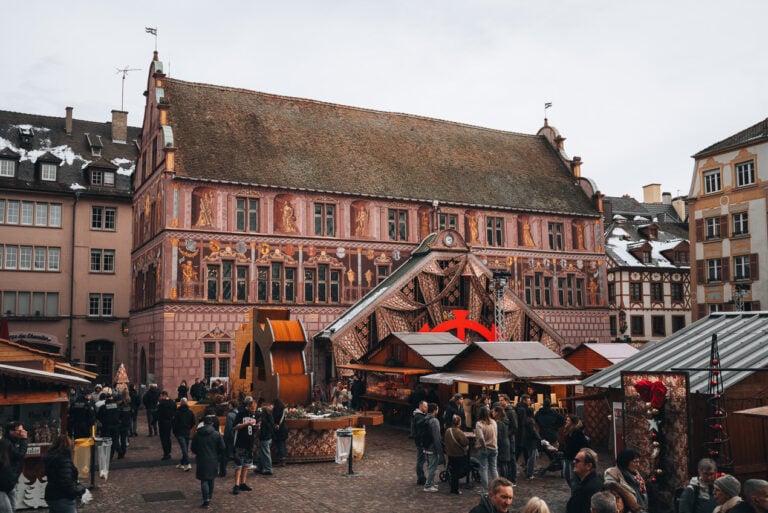
I followed my nose straight into Place de la Réunion, where the whole square was glowing under garlands of Christmas fabric. I stood there with a warm slice in one hand and forgot I was ever lost.
That was my first winter here back in 2019, and I’ve come back every single year since. Mulhouse kicks off my holiday season, every time, without fail.
It doesn’t get the hype that Strasbourg or Colmar do, and honestly, that’s part of why I love it.
So let me walk you through the market the way I’d actually explore it: the attractions worth your time, the food I keep coming back for, where to eat when your fingers go numb, and the little lessons I learned the hard way.
This post contains affiliate links, meaning I may earn a commission if you make a purchase by clicking on a link (at no extra cost to you). Disclosure Policy
Why Visit Mulhouse’s Christmas Market

Mulhouse doesn’t have the fame of Strasbourg or the fairytale polish of Colmar, and that’s exactly what makes it worth your time. The crowds are thinner, the vendors are chattier, and the market has a character that’s entirely its own.
At the heart of it is something I’ve never seen at any other market in Alsace: a theme built around fabric. Every year, a new cloth is designed, and it shows up everywhere, draped across chalets, printed on souvenirs, and wrapped around the market’s whole identity.
I’ll be honest — the first year I visited, I barely noticed it. It wasn’t until my second trip, when I spotted the same bold pattern on tablecloths, vin chaud mugs, and market banners, that it finally clicked.
Once you see it, you can’t unsee it, and it gives Mulhouse a cohesion and personality that’s hard to find elsewhere. It’s one reason I love visiting every year.
Dates and Opening Hours for 2026
Dates: 20 November to 27 December
Hours:
- Monday to Thursday: 11:00 am to 8:00 pm
- Friday to Sunday: 10:00 am to 9:00 pm
- 24 December: 11:00 pm to 6:00 pm
- 25 December: Closed
- 26 December: 12:00 pm to 9:00 pm
- 27 December: 10:00 am to 6:00 pm
What I Do vs. What Most Visitors Do


I’ve watched a lot of first-timers make the same well-meaning mistakes here. So here’s the tourist version and my version, side by side.
- The Three Christmas Markets: Most visitors crowd into Place de la Réunion in the busy afternoon, snap a few photos, and leave. I go before the markets open, when the History Museum glows behind the chalets, then wander over to the quieter Place de la Concorde and Place des Cordiers, where the vendors actually have time to talk.
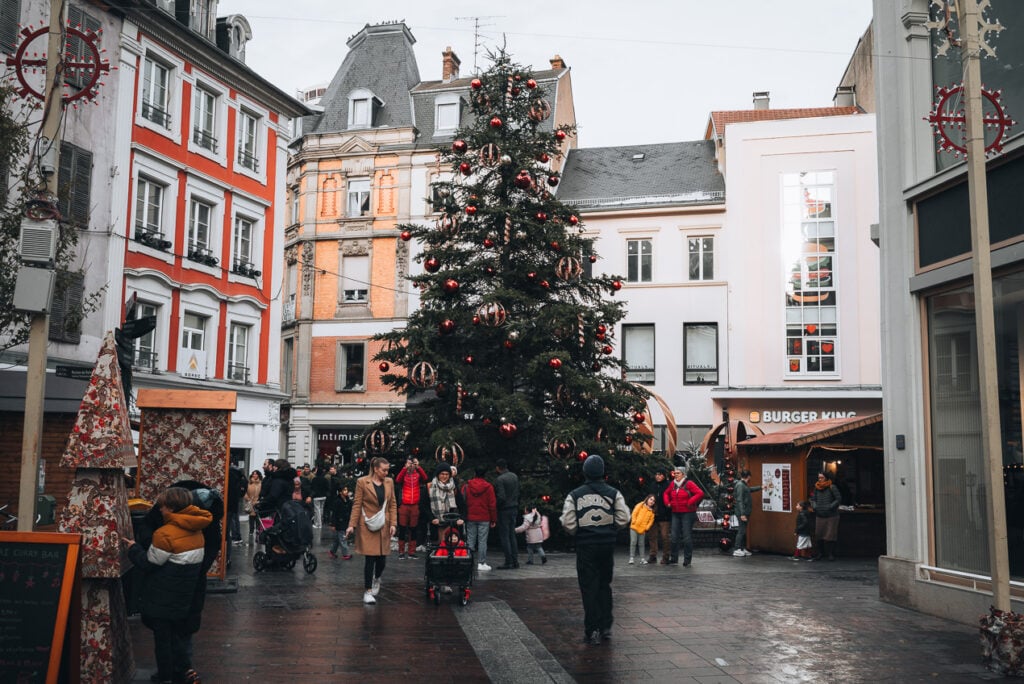
- Place des Victoires: Tourists often expect a Strasbourg-sized spectacle and feel let down by the modest tree. I go for exactly that reason — it’s calm, and once I had the whole spot to myself with a hot chocolate.
- Temple Saint-Étienne: Most people peek inside and move on. I check the concert schedule and plan my evening around it, ever since I ducked in to warm up and stayed for an entire, chill-inducing performance.
- Hôtel de Ville – Musée Historique: Visitors treat this free museum as a rainy-day backup. I treat it as a highlight, and I never leave without browsing La Boutique aux Etoffes downstairs for crafts made from the year’s Christmas fabric.
- Square de la Bourse: This is the big one people miss. Tired tourists head back to their hotels before the nightly light and sound show. I stay, every time, because it’s the moment that makes the whole trip.
The Foods I Go Back for Every Time
Alsace has a lot of regional dishes, but a few are specific to Mulhouse and southern Alsace.
This is honestly the part of the trip I look forward to most.
- Fleischschnacka: This is THE specialty of Mulhouse, and I still remember my first bite. It’s large noodles filled with meat and rolled to look like a snail, which sounds odd until you taste it. I was skeptical, took one hesitant forkful, and immediately went back for a second helping. It’s now the dish I hunt down every single visit.
- Fried carp: This comes from southern Alsace, so you’ll find plenty of it in Mulhouse. The fish is fried until crisp and served with French fries and a salad. It’s simple, hot, and exactly what you want after an hour in the cold.
Then, there are a few others worth trying, but you’ll find these at most Christmas markets around Alsace.
- Tarte flambée: This pizza-like dish is my favorite market snack, and yes, it’s the one that rescued me on that first lost-and-cold evening. It’s a thin base topped with crème fraîche, caramelized onions, savory lardons, and melted cheese.
- Choucroute garnie: My favorite traditional dish, hands down. It’s sauerkraut, pork, and potatoes. Simple, hearty, and the kind of meal that makes you loosen your scarf and settle in.
- Baeckeoffe: A slow-cooked casserole made with potatoes, onions, carrots, and a trio of meats: beef, pork, and lamb. When the lid comes off and the steam hits your face, it’s pure comfort.
- Bredele: These spiced cookies only appear at Christmas, and they come in dozens of shapes and flavors. I always buy a bag “for later” and finish them before I reach my hotel.
- Pain d’épices: The Alsatian version of gingerbread, made with honey, cinnamon, and ginger. This is the one that gentleman gave me a sample of, and I’ve been hooked ever since.
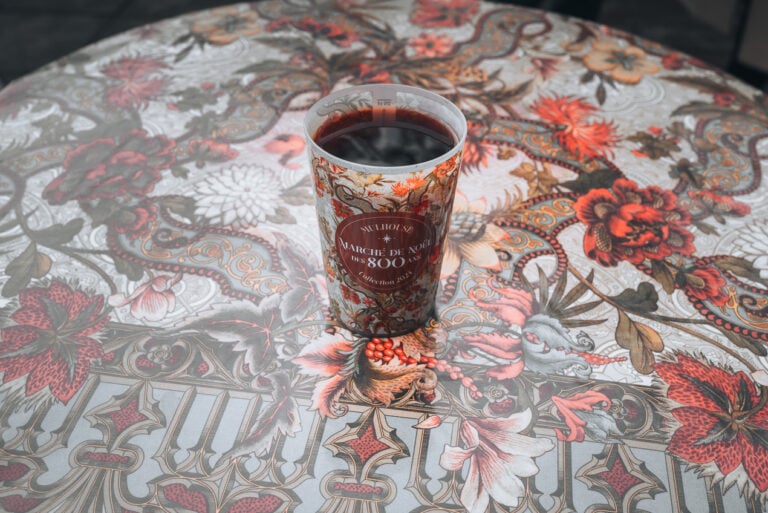
- Vin chaud: This warm mulled wine is made with red or white wine, sugar, cinnamon, and cloves. It comes in a collectible cup decorated with the year’s Christmas fabric, and I’ll admit I’ve kept more than a few. Wrapping my hands around that warm cup is my favorite part of any market evening.
Practical Information

How to Get to Mulhouse
Getting to Mulhouse is straightforward. Its main train station is well-served and can be reached from cities like Paris, Lyon, and Strasbourg. It’s near the city center and within walking distance of the Christmas market, with signs pointing the way.
Helpful Tip: Mulhouse has excellent public transport.
If you’re traveling from abroad, the nearest airports are Strasbourg Airport, EuroAirport, Frankfurt Airport, and Paris (CDG and Orly).
- EuroAirport: Near St. Louis, this airport is 31 kilometers (19 miles) from Mulhouse. You can rent a car or take the train (about 40 minutes).
- Strasbourg Airport: Rent a car and drive to Mulhouse, or take the train.
- Frankfurt Airport: Although in Germany, it’s easy to reach Alsace from here. Take the train, rent a car, or hop on the Lufthansa Express Bus to Strasbourg, then take a train to Mulhouse.
- Paris Airports (CDG & Orly): Direct trains run from CDG to Strasbourg’s main train station (two hours), where you can change for Mulhouse. From Orly, transfer to Gare de l’Est and take a train to Mulhouse.
Helpful Tip: The best website to buy your train tickets is SNCF-Connect.
Where to Stay
Mulhouse gets busy during the holiday season, but it’s not as bad as Strasbourg or Colmar. Here are a few options that will guarantee an enjoyable stay:
- Hotel Bristol: An elegant hotel in the center of Mulhouse. The breakfast is delicious, and the staff is friendly.
- Brit Hotel Mulhouse Centre: An affordable hotel with beautiful rooms. They even have on-site parking.
- Gîte des Victoires: A fully equipped apartment with a responsive host. It’s conveniently located, and the beds are comfortable.
Where to Eat
If you haven’t eaten enough at the market, there are plenty of restaurants in town. These are the ones that earned a permanent spot on my list.
- La Table de Michèle: A traditional Alsatian restaurant with an impressive wine list. I came here for a friend’s birthday dinner one year, and the warm, cozy setting plus a glass of local white made it one of those meals I still talk about. It’s the place I book when I want the evening to feel special.
- La Piadina: A French brasserie with excellent food and relaxed service. I ended up here on a whim after a long, cold day, expecting nothing, and left already planning my next visit. The unfussy, welcoming vibe is exactly what I wanted.
- Restaurant Zum Sauwadala: A traditional Alsatian restaurant that even draws locals, which is always a sign of a good one. This is where I finally had a proper sit-down plate of Fleischschnacka, and it’s the meal that turned my market-snack curiosity into a full-on obsession.
What I Wish Someone Had Told Me

Since moving to Alsace in 2019, I’ve learned a lot about navigating these markets, mostly by getting it wrong first.
My biggest lesson? Bring cash. My very first year, I picked out an armful of gifts at a craft stall, got to the front of the line, and realized the vendor only took cash. I had to sheepishly put everything back. Not every vendor accepts cards.
Here are the rest of my hard-won tips:
- Take a photo of the market map. There are several posted around town (see the photo above). It saved me from getting lost.
- Check out my favorite websites to make planning your trip to this part of France easier.
- Wear comfortable shoes. You will walk a lot.
- Winter can be cold and rainy in Mulhouse. Pack warm clothing like hats, scarves, gloves, thermal layers, and an umbrella. (It does snow, but not every year.)
- Reserve accommodations and restaurants as early as you can.
- To dodge the crowds, visit early to mid-morning or late evening on weekdays.
- You don’t have to be fluent in French, but a simple “Bonjour” goes a long way.
Why I Keep Coming Back
People always ask me how Mulhouse compares to the big-name markets, and here’s my honest take. Strasbourg is grander, and Colmar is more of a fairytale, but both can feel like you’re being swept along in a river of people.
Mulhouse lets you actually stop and breathe.
The fabric theme gives it a look you won’t find anywhere else, the light show at Square de la Bourse still gives me goosebumps, and the vendors have time to chat instead of rushing you along.
It’s the difference between watching a spectacle and being part of a community celebration.
If you only remember one thing from this guide, let it be this: follow your nose, bring cash, and don’t rush. That’s exactly how I’d do it.
And if you want help planning the rest of your Alsace trip around the market, I offer personalized travel planning consultations where we can map it all out together.
Read More Articles
I hope you enjoyed my post and found it helpful. Here are some other articles that I think you will find interesting.
- My 5-Day Alsace Christmas Market Itinerary for First-Timers
- A Local’s Guide to the Navettes de Noël in Alsace
- The Ultimate Eguisheim Christmas Market Guide
- The Ultimate Kaysersberg Christmas Market Guide
- The Ultimate Obernai Christmas Market Guide
- The Ultimate Riquewihr Christmas Market Guide
- The Ultimate Sélestat Christmas Market Guide
- The Ultimate Turckheim Christmas Market Guide
