Dijon is a city that has earned a place in my heart. After nearly a decade living in France, I’ve visited a lot of cities.
And it’s true that Dijon doesn’t have the same star power as Paris or Lyon, but it has a certain je ne sais quoi that’s hard to put into words.
Its history dates back centuries, its architecture is impressive, and its cuisine is delicious. It perfectly combines all these things to give the feel of a lively city.
Yet, it still manages to keep an intimate atmosphere.
As with any destination, however, there are pros and cons to consider before making the decision to visit.
In this article, I’ll weigh the pros and cons of visiting Dijon to help you decide if it is worth a spot on your travel list.
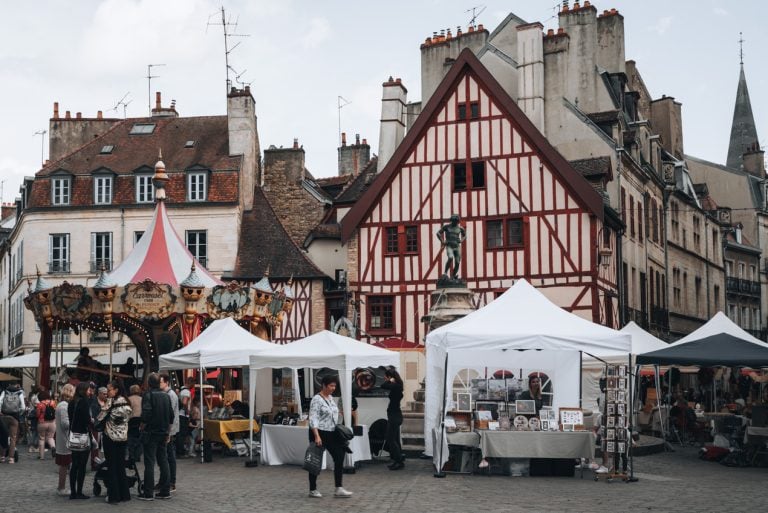
15 Pros and Cons of Visiting Dijon
1. Pro: Easy to Visit in One Day

One of the biggest advantages of visiting Dijon is that it can be explored in one day.
It’s compact and very walkable, so you can see all the main attractions without feeling rushed.
One of the best ways to visit Dijon’s best sites in a single day is to follow Le Parcours de la Chouette (The Owl Trail). This self-guided walking tour takes one to two hours and passes by nearly every historical monument.
Free Printable Guide
Sign up for a free printable version of this guide. It’s 20 pages of tips, sample itineraries, and more.

2. Con: Limited Tourist Infrastructure

When I say limited tourist infrastructure, I don’t mean there is a lack of hotels or public transport.
There are lots of activities in Dijon, but it’s hard to find information. As an example, the first time I visited, I wanted to climb the Philippe le Bon tower.
I went to the tourist office only to find out there are very few tours per day and tickets need to be reserved.
For such a significant monument, I would have thought there would be lots of tours throughout the day.
3. Pro: Fascinating History

Dijon has a long and fascinating history that dates to early Roman settlements. But its significance in Europe began with the Dukes of Burgundy.
From the 11th century to the 15th century, they called Dijon their home and propelled it toward wealth and prosperity. And it kept this luxurious status for centuries after their rule.
In fact, many of the historical monuments you see today are from the Dukes of Burgundy.
There’s the Palais des Ducs de Bourgogne, the Rude Museum, the tower of Philippe le Bon, and much, much more.
4. Con: Not a City for Wine Tours

As the capital of Burgundy, you might expect Dijon to have a lot of wineries. Unfortunately, this is not the case.
Dijon is a city for history and culture, which can be both a pro and a con, depending on what you want to do.
If you’re looking for a city that has a lot of wineries and wine tastings, Beaune is the place to visit rather than Dijon. It’s more known for its wine production and is better suited for wine tours.
5. Pro: Lots of Parks and Gardens

Even though Dijon is known for its history and culture, it also has lots of parks and gardens.
One of my favorites is the Arquebuse Botanical Gardens. Here you’ll find gravel walking paths, flourishing gardens, and small picnic areas.
Then there is Lake Kir. It’s a stunning lake that is surrounded by walking and cycling paths. And, in summer, there is a section of the lake that is turned into a beach.
6. Con: Short Stay Destination
On the downside, Dijon is just that. It’s a short-stay destination.
There’s only so much you can do and see in such a small city.
So, if you’re looking for a weekend getaway or a quick stop while traveling through France, Dijon is perfect.
But I would not recommend it as a main vacation spot.
7. Pro: Delicious Food

Dijon is home to 30 Michelin-starred restaurants.
That’s quite a big number for a town of this size. If you’re looking to splurge on a dining experience, this would be the place to do it.
But there are also lots of affordable restaurants that serve traditional dishes like beef bourguignon.
Of course, I can’t talk about the food in Dijon without mentioning its mustard. You can even visit the original Maille boutique and sample a few different flavors.
8. Con: Cuisine May Not Suit Everyone
While Dijon is known for its delicious food, it may not suit everyone’s palate.
French cuisine tends to be rich and heavily meat-based.
Most efforts are being made to offer alternative options.
There’s also the Halles Centrales market in Dijon that sells fresh produce and vegetables.
9. Pro: Incredible Architecture

Dijon is also home to some stunning architecture, so plan on taking lots of photos.
The city’s most iconic landmark is the Palais des Ducs de Bourgogne, a magnificent palace with a mixture of styles, including Gothic.
Other notable architectural gems include the Church of Notre-Dame, Saint-Benigne Cathedral, and the buildings along Rue des Forges.
10. Con: Cold and Damp Winters
One downside of Dijon is its cold and damp winters.
The city experiences about 10 days of rain per month (during the winter months), and temperatures can drop below freezing.
The first time I visited Dijon was in winter, and the cold and humidity cut through my jacket, leaving me shivering and miserable.
If you bundle up and are ready for it, it’s tolerable. Don’t do what I did and come unprepared.
Free Printable Guide
Sign up for a free printable version of this guide. It’s 20 pages of tips, sample itineraries, and more.
11. Pro: It’s Not Overcrowded

Have you ever been to a city that was so overrun with tourists that it felt like a zoo?
Think Paris in August.
Luckily, Dijon isn’t like that.
In fact, it’s often skipped for more popular destinations.
If you’re in France during the high season, Dijon is a great city to visit. There are fewer crowds, and prices for accommodation and activities are still affordable.
12. Con: Not a Major Hub
If you’re traveling from abroad, Dijon is not as easy to reach as other cities like Paris, Lyon, or Strasbourg.
There are high-speed TGV trains that run from France’s major cities to Dijon, but you’ll first need to fly into one of those cities.
It adds an extra step to your travel plans and may not be convenient.
13. Pro: Well-Located in France

On the other hand, if you’re already in France and traveling by train, Dijon is easy to reach.
High-speed TGV trains that run from Paris to Lyon stop in Dijon. A day trip from Strasbourg is also an option. This is what I did, and my train took about two hours.
Regional TER trains and buses also pass by regularly.
So, you could even visit other popular towns in Burgundy like Beaune, Besançon, and Semur-en-Auxois.
14. Con: Limited Nightlife

Dijon may be a popular destination for food and history enthusiasts, but it doesn’t offer much in terms of nightlife.
This can be both a positive and a negative aspect, depending on your preferences.
If you’re looking for a lively and bustling nightlife scene, Dijon may not be the place for you.
However, if you prefer a more laid-back and quiet evening, then it’s perfect.
15. Pro: Lots of Museums

One of the best things to do in Dijon is to visit a museum. These magnificent institutions do a wonderful job of showcasing the city’s heritage.
And each one offers insight into Dijon’s past and present.
My favorite museums were the Musée Rude, Musée des Beaux-Arts, and Musée de la Vie Bourguignonne. All of which are free.
Then, there’s the Mulot and Petitjean Gingerbread Museum, the Consortium Museum, and the Musée Magnin. They aren’t free to visit, but I found them just as interesting.
Free Printable Guide
Sign up for a free printable version of this guide. It’s 20 pages of tips, sample itineraries, and more.
Conclusion
If you’re planning a trip to France, it’s safe to say that Dijon is worth adding to your itinerary.
The locals are welcoming, and the atmosphere is laid-back, making it a stress-free vacation.
It’s also easy to get to from any major city.
And now that you know you want to add it to your itinerary, why not check out other towns in Burgundy, like Beaune? There are a ton of things to do here.
Read More Articles
I hope you enjoyed my post and found it helpful. Here are some other articles that I think you might find interesting.
